


Views: 0 Author: Site Editor Publish Time: 2025-11-26 Origin: Site


Looking for a simple way to make your home green? A heat pump water heater is easy to use and makes a big difference. This system uses less energy than regular water heaters. You can save as much energy as six solar panels make in one year. You also help the Earth by cutting over 2,000 pounds of CO2 each year. That is like planting 17 trees for ten years!
| What You Get | Details |
|---|---|
| Energy Efficiency | 2-3 times more efficient than regular water heaters |
| Annual CO2 Savings | Over 2,000 pounds (same as growing 17 trees for 10 years) |
| Clean Energy Impact | Same as what six solar panels make in a year |
You get a useful solution for every day. You do not need to change your life in a big way.
If you use a heat pump water heater, you can save more than $300 each year on your energy bills. This system lowers greenhouse gas emissions by over 2,000 pounds every year, which helps the planet. Heat pump water heaters work two to three times better than regular models, and they give you hot water you can count on. You can get tax credits and rebates, so this is a good investment for the future. Installing one is easy and you do not need to change much in your home or your daily habits.

A heat pump water heater is a super-efficient water heater that helps you save energy and protect the planet. You might see these units called energy star certified because they meet strict guidelines for saving power. This type of water heater uses smart technology to heat your water in a way that’s different from regular models.
You might wonder how a heat pump water heater does its job. Instead of making heat, it moves heat from the air around it into the water tank. This process is a lot like how your refrigerator works, but in reverse. Here’s what happens:
The system pulls in warm air from your home.
It uses a special coil filled with refrigerant to absorb the heat.
A compressor boosts the temperature of the refrigerant.
The hot refrigerant moves through coils around the tank, warming the water inside.
This method uses much less electricity than traditional water heaters. In fact, a heat pump water heater can be two to three times more efficient than a standard electric model. That means you get hot water while using less energy and saving money.
Tip: If you choose an energy star certified model, you can save even more on your utility bills.
Here’s a quick look at the main parts that make this system work:
| Component | What It Does |
|---|---|
| Heat Pump Technology | Moves heat into the water tank |
| Evaporator Coil | Absorbs heat from the air |
| Compressor | Raises the temperature of the refrigerant |
| Condenser Coils | Transfers heat to the water |
| Foam Insulation | Keeps the heat inside the tank |
| Dual Heating Elements | Helps heat water quickly when you need a lot |
You may hear people call this a hybrid electric water heater. That’s because it combines two ways to heat water. Most of the time, it uses the heat pump to move warmth from the air. When you need extra hot water fast, it switches to electric heating elements. This smart design gives you reliable hot water and top-notch efficiency.
So, if you want a water heater that’s easy on your wallet and the environment, a heat pump water heater is a great choice.
You want to save energy and pay less for hot water. A heat pump water heater helps you do both. It uses warm air to heat water, so it needs less electricity than old heaters. This system is two to three times more efficient than regular ones. You still get hot water for showers and dishes, but you use less power.
Check out how water heaters compare:
| Water Heating Technology | Energy Efficiency Rating (UEF) | Operating Costs Comparison |
|---|---|---|
| Heat Pump Water Heaters | Higher UEF values | Lower operating costs |
| Gas Storage Water Heaters | Lower UEF values | Higher operating costs |
| Electric Storage Water Heaters | Lower UEF values | Higher operating costs |
If you pick an energy star certified heat pump water heater, you can save even more money. Many families save $200 to $550 each year. Some models can save you up to $550 a year compared to regular electric heaters. That’s extra money for things you like.
Tip: The Uniform Energy Factor (UEF) tells you how efficient your water heater is. Higher numbers mean better savings and performance.
You want to help the planet. Using a heat pump water heater means you use less electricity. Power plants burn fewer fossil fuels, so less pollution goes into the air.
Here’s what you can expect:
You can cut your home’s carbon emissions by at least 2,000 pounds each year.
If every single-family home in the U.S. switched, we could cut 160 million metric tonnes of emissions each year.
Energy star certified models help you use clean energy and protect the environment.
You help the Earth in other ways too. Heat pump water heaters last longer, so you throw away fewer units. Many models have leak detection, which saves water and stops waste. Every small step helps make your home greener.
You might think going green is hard, but a heat pump water heater makes it simple. Installing one is a lot like putting in a regular electric water heater. You don’t need to change your whole house or your daily habits.
Here are some things that make it easy:
You can put it where your old water heater was.
The unit needs open air, but most homes have enough space.
You can reach the control panel easily for quick changes.
Most tanks have built-in insulation, so you don’t need extra blankets.
You can use a mixing valve to keep water at the right temperature.
If you have long pipes, an on-demand pump moves hot water fast and saves energy.
| Requirement | Description |
|---|---|
| Similar Installation | Installing a Heat Pump Water Heater is like installing an electric resistance water heater. |
| Accessibility | Place the unit so you can reach the control panel and for service. |
| Air Path Clearance | Make sure the air path is open for best operation. |
| Mixing Valve | Use a thermostatic mixing valve to control temperature and store more hot water. |
| Insulation | Insulate hot water pipes to help the system work better and follow local rules. |
| Tank Insulation | Most units have insulation inside, so you don’t need a blanket. |
| Circulation Pump | Use an on-demand pump for long pipes; don’t run it all the time to save energy. |
| Seismic Strapping | Check local rules for strapping if you live where earthquakes happen. |
| Operational Modes | Learn about the four main modes: Economy, Heat Pump Only, Resistance Only, and Vacation. |
You get all these benefits without much trouble. You just swap your old water heater for an energy star certified heat pump water heater. You start saving money and energy right away. You make your home greener and more efficient with one easy upgrade.
You want to spend less on energy bills. A heat pump water heater helps you save money. The price at first is higher, but you save more later. A family of four can save up to $550 each year. This happens when you switch from a regular electric water heater to an ENERGY STAR® certified heat pump model. If you use a hybrid heat pump water heater, you can save about $350 a year. These savings add up fast and help pay for your new water heater.
| Benefit Type | Description |
|---|---|
| Tax Credits | Homeowners can get a 30% tax credit for heat pump installations, up to $2,000. |
| Energy Efficient Home Improvement Credit | Pays for 30% of costs for energy upgrades, including heat pumps. |
| Electrification Rebates | Low and moderate income families can save up to $1,750 on heat pump water heater costs. |
| Long-term Energy Savings | You save a lot of money on energy over the life of the heat pump water heater. |
Tip: Even if the price is higher at first, you save money with lower energy bills. A heat pump water heater is a smart choice.
You do not need to worry about hard upkeep. Heat pump water heaters are simple to care for. Here is what you should do:
Check and clean air filters every month.
Look at and clean the condenser and evaporator coils when needed.
Make sure nothing blocks the unit so air can flow.
Check the anode rod once a year to stop rust.
Watch the temperature and pressure valve.
Flush the tank every year to get rid of sediment.
Insulate hot water pipes to keep heat inside.
Most problems are easy to fix, like checking the power or cleaning filters. If you have bigger problems, you can call a professional.
You might worry about noise. Heat pump water heaters run at about 40 to 60 decibels. This is like a quiet talk in a restaurant. The sound is just a soft hum in the background. Most people do not notice it during the day.
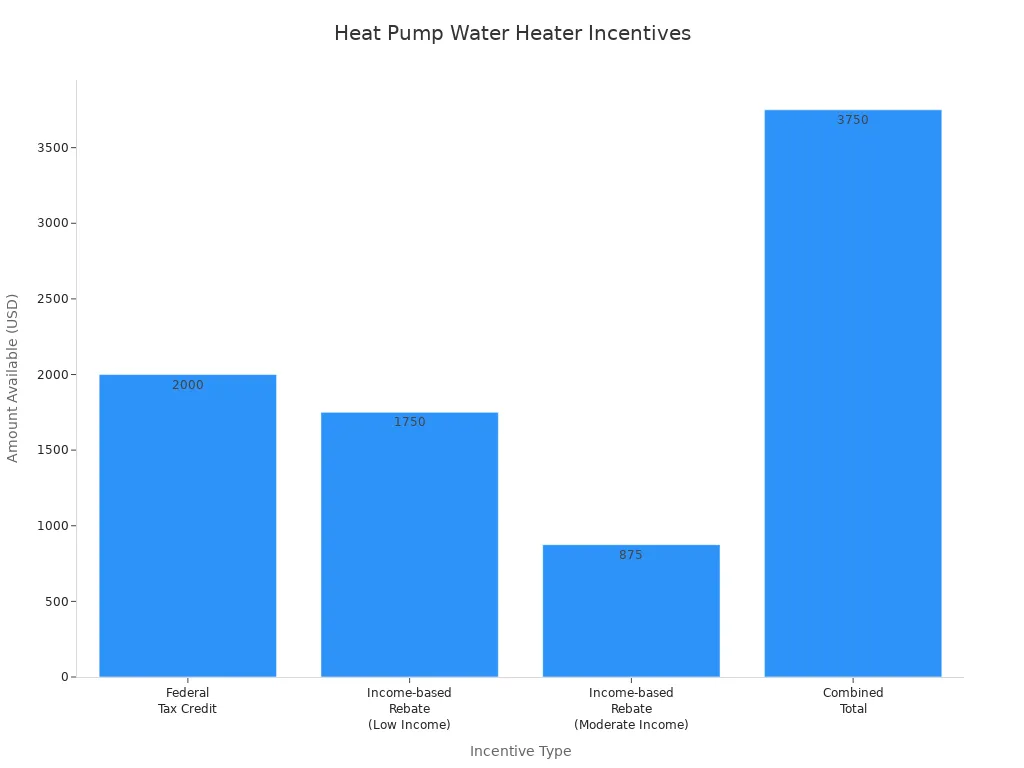
You can get good rebates and incentives when you install a heat pump water heater. Federal tax credits pay up to $2,000 or 30% of your installation cost. If you are a low or moderate income family, you can get up to $1,750 in rebates. Some people can get both and save up to $3,750.
| Type of Incentive | Amount Available | Eligibility Criteria |
|---|---|---|
| Federal Tax Credit | Up to $2,000 or 30% of installation cost | Must meet Energy Star efficiency standards |
| Income-based Rebate (Low Income) | Up to $1,750 | Must meet Energy Star efficiency standards |
| Income-based Rebate (Moderate Income) | Up to $875 | Must meet Energy Star efficiency standards |
| Combined Total | Up to $3,750 | If both tax credit and rebate are applied |
You save money, enjoy easy care, and help the planet with one upgrade.
You might wonder how to set up a heat pump water heater in your home. The process is simple if you follow a few steps. First, pick a spot that stays between 40°F and 90°F all year. Make sure the area has at least 1,000 cubic feet of air space. A garage or basement works well. Next, get the site ready. The floor should be flat and strong enough to hold the unit.
Here’s a quick guide to the main steps:
Prepare the installation site. Check space, ventilation, and make sure the floor is level.
Install the heat pump unit and water tank. Follow the instructions from the manufacturer.
Connect the cold water supply to the tank.
Hook up the electrical wiring to match the unit’s needs.
Fill the tank, check for leaks, and turn on the system for a test run.
Tip: You don’t need special tools, but hiring a professional helps you avoid mistakes and keeps your family safe.
You can swap out your old electric water heater for a heat pump model without big changes. Most homes already have the plumbing and wiring needed. The main difference is space and air. Heat pump water heaters need more room to work well. They need at least 1,000 cubic feet of air space and should be placed in warmer spots.
| Feature | Heat Pump Water Heater | Conventional Water Heater |
|---|---|---|
| Operating Temperature Range | 40-90°F (4.4-32.2°C) | No specific range required |
| Air Space Requirement | At least 1,000 cubic feet around the unit | Minimal air space required |
| Efficiency in Cold Climates | Not effective in colder climates | Generally effective in all climates |
| Ideal Installation Locations | Warmer areas with excess heat (e.g., garage) | Can be installed in various locations |
After you install a heat pump water heater, you notice the benefits right away. You get reliable hot water for showers, laundry, and dishes. You start saving money over time, even if installation costs seem high at first. Federal tax credits and local rebates help lower those installation costs, so you see a faster payback. Most people find the system quiet and easy to use. You just set the temperature and let it run. You enjoy lower bills and help the planet every day.
You may wonder if a heat pump water heater helps people like you. Many families in North America have switched and see good results.
“I got rid of my old fossil gas water heater. I put in a Rheem Performance Platinum heat pump water heater. I feel happy with my choice. I do not worry about health problems from old water heaters now.”
You can find stories like this in lots of places. People pick heat pump water heaters to save money and feel safer at home. Here are some things they say:
Homeowners change old electric water heaters for heat pump models to lower energy bills.
You can cut your home’s energy use by half with a heat pump water heater.
More families in cities and suburbs pick these systems because they want to help the planet.
Let’s look at some facts:
A family of four in New England switched to a heat pump water heater. They save about $380 each year. Their old electric heater cost $1,147 every year.
Using the average electric rate in the country, the same family saves about $207 each year. Their old heater cost $624 each year.
You see real savings and a greener home when you switch.
You help the planet when you use less energy. Heat pump water heaters are two to three times more efficient than regular electric water heaters. You use less electricity, so power plants burn fewer fossil fuels.
You can use your heat pump water heater with solar panels for even more energy savings.
These systems do not make direct emissions. The only emissions come from the electricity source, but you still make less pollution than with old heaters.
Most homes with heat pump water heaters have lower greenhouse gas emissions.
You make a real difference for your community and the planet. Every upgrade helps make a cleaner future.
Switching to a heat pump water heater is one of the easiest ways you can go green at home. You get big energy savings, help the planet, and enjoy simple use every day. Here’s what you gain:
Save over $300 a year on bills.
Cut greenhouse gas emissions.
Make a smart long-term investment with rebates.
| Feature | Heat Pump Water Heater | Traditional Water Heater |
|---|---|---|
| Energy Efficiency | High | Low |
| Cost Savings | Significant | Minimal |
| Emissions | Lower | Higher |
Ready to make your home greener? Check out your options or talk to a local installer today!
You need at least 1,000 cubic feet of open air around the unit. Most garages or basements work well. If you have a small closet, this type may not fit.
You can use it in cooler places, but it works best in areas that stay above 40°F. If your basement gets cold, the unit may switch to electric mode more often.
No, it runs quietly. You’ll hear a soft hum, like a fridge or a quiet fan. Most people don’t notice it during daily life.
You should check the air filter every month. Clean it when it looks dirty. Flush the tank once a year. Most tasks take just a few minutes.
You can try if you feel confident with plumbing and electrical work. Many people hire a pro to make sure everything works safely and meets local codes.


