


Views: 0 Author: Site Editor Publish Time: 2026-05-20 Origin: Site


Commercial facilities face mounting pressure to reduce operational expenses today. Hotels, hospitals, and high-volume kitchens must urgently cut their energy consumption. They also face strict new carbon emissions regulations across multiple regions. Traditional electric resistance heaters and gas boilers drain budgets rapidly. They are fast becoming unsustainable liabilities for modern building owners. Facility managers clearly need a reliable way to solve this ongoing energy crisis.
Upgrading to a commercial heat pump offers the most viable path to decarbonization. However, standard models often struggle to manage highly variable hot water loads efficiently. They cycle on and off, wasting energy during fluctuating demand periods.
DC inverter technology solves this problem by precisely modulating compressor speeds. This dynamic operation unlocks deeper efficiency and smoother load management. It delivers a much faster return on investment without ever compromising hot water delivery. You will learn how these advanced systems operate, how to size them, and how they protect your facility against future regulatory shifts.
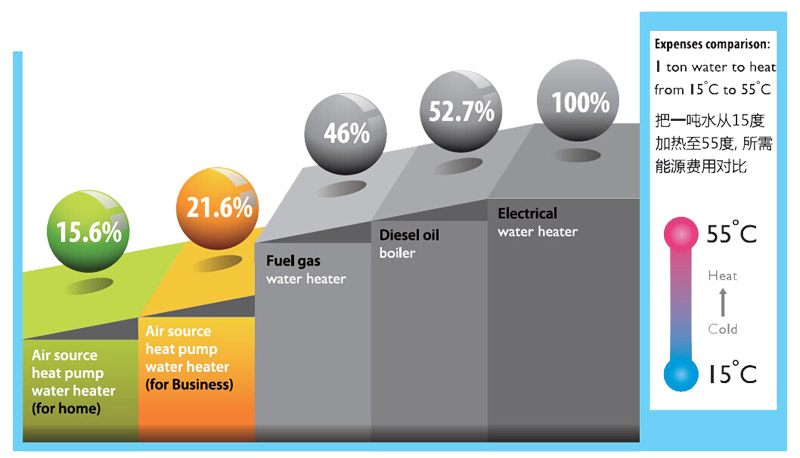
Accelerated Payback: Industry data shows a 3.2 to 4.4-year average payback period for high-volume commercial applications due to 50%+ reductions in energy usage.
Operational Superiority: DC inverter compressors ramp up and down smoothly, offering up to 30% greater part-load efficiency compared to traditional fixed-speed scroll compressors.
Installation Realities: Successful deployment requires upfront planning for physical footprint (ambient airflow), electrical loads, and acidic condensate management.
Future-Proofing: Selecting systems with low-GWP refrigerants (R290/CO2) and smart grid integration (EcoPort/CTA-2045) shields investments from upcoming regulatory shifts.
Switching from legacy water heating systems to advanced heat pumps fundamentally changes your facility's financial outlook. Traditional equipment burns fuel or uses massive electrical resistance to generate heat. A heat pump moves existing ambient heat from the air into your water supply. This mechanism completely redefines commercial energy efficiency.
You measure heating efficiency using the Coefficient of Performance (COP). Standard electric resistance heaters max out at a COP of 1.0. This means one unit of electricity yields one unit of heat. A modern DC inverter heat pump operates at a COP ranging from 3.0 to 5.0. It transfers ambient heat rather than generating it from scratch. You get three to five units of heat for every single unit of electricity consumed.
System Type | Average COP | Energy Mechanism | Efficiency Gain |
|---|---|---|---|
Electric Resistance | 0.9 - 1.0 | Generates heat directly | Baseline |
Gas Boiler | 0.7 - 0.9 | Combusts fossil fuels | Negative (Heat lost in exhaust) |
Standard Heat Pump | 2.0 - 3.0 | Transfers ambient heat | Up to 200% over baseline |
DC Inverter Heat Pump | 3.0 - 5.0 | Transfers heat with variable modulation | Up to 400% over baseline |
Facility owners often worry about the initial capital expenditure of heat pump installations. However, field data strongly supports the upgrade. The Electric Power Research Institute (EPRI) conducted extensive findings on commercial applications. Their research demonstrates that commercial heat pumps routinely cut energy use by over 50%. This massive reduction translates to thousands of dollars in annual savings. For high-volume users like restaurants and hotels, the average payback period shrinks to just 3.2 to 4.4 years.
Commercial utility bills usually include severe peak demand charges. Utilities penalize buildings for their highest 15-minute power draw during the month. Heat pumps offer a brilliant financial strategy to avoid these spikes. You can run the heat pump during off-peak nighttime hours. The system stores the generated hot water in insulated tanks. When peak morning demand hits, you draw from the stored water instead of turning on heaters. This peak load shifting drastically reduces costly demand charges.
Heat pumps act like refrigerators operating in reverse. They pull heat out of the surrounding air and push it into the water. This process creates a valuable byproduct: cold, dehumidified air. Running these units indoors absorbs excess ambient heat. They indirectly reduce your facility’s HVAC cooling loads. This secondary benefit proves especially valuable in overheated environments like commercial kitchens, laundry rooms, or IT server rooms.
Not all heat pumps perform equally under commercial stress. Legacy models rely on fixed-speed compressors. They simply turn on at 100% capacity or turn completely off. This clunky operation wastes energy and creates uncomfortable temperature fluctuations.
Unlike standard on/off compressors, an inverter model dynamically adjusts its power output. It precisely matches the real-time hot water demand of your building. If the hotel needs just a little hot water at noon, the compressor spins slowly. When morning showers peak, it ramps up fully. This modulated approach maximizes ongoing energy saving efforts.
Compressor architecture dictates long-term efficiency and durability. Most legacy commercial systems utilize fixed-speed scroll compressors. Modern inverter models feature twin rotary compressors. Twin rotary designs minimize internal friction. They also eliminate heavy cycling losses. Because the twin rotary mechanisms balance each other out, they yield up to 30% more energy savings than legacy fixed-speed scroll configurations.
Standard compressors suffer from aggressive "hard starts." A sudden surge of electricity jolts the mechanics awake, causing severe wear over time. Continuous, variable-speed operation prevents this mechanical trauma. Soft starting greatly extends the lifespan of the equipment. Furthermore, eliminating hard starts significantly lowers operating noise. Some advanced commercial units now operate at sound levels as low as 35dB(A), making them nearly silent.
Commercial facilities cannot afford sudden cold water shocks. Fixed-speed heaters often fail to keep up when tank levels drop rapidly. Inverter technology prevents this entirely. Slower, modulated ramping maintains a perfectly stable water temperature. It prevents the sudden fluctuations commonly experienced during peak draw times in commercial facilities.

Improper sizing ruins the efficiency of even the best heat pumps. Facility managers frequently make the mistake of buying equipment based solely on storage tank volume. True commercial sizing requires a much more analytical approach to match your unique building architecture.
You must guide buyers away from simple tank volume metrics. A 120-gallon tank means nothing if the system takes ten hours to reheat it. Focus on calculating the peak hourly draw. You need to know the absolute maximum amount of water used during the busiest hour of the day. Next, evaluate the system's first-hour recovery capability. This metric tells you exactly how many gallons the heat pump can deliver during that critical peak hour.
Follow these steps for accurate capacity assessment:
Audit historical water usage data during peak operational hours.
Calculate the necessary first-hour rating (FHR) for your specific facility type.
Select a compressor size capable of meeting the recovery rate.
Determine the physical space available for storage tanks.
Manufacturers design heat pumps in two distinct physical configurations. Your choice depends entirely on your climate, space, and daily volume.
Integrated Models: These units combine the compressor and the tank into one single cylinder. They are best for light commercial drop-in replacements under 120 gallons. They currently cover about 80% of legacy commercial upgrades.
Split Systems: A split type heat pump is ideal for heavy commercial use. The evaporator sits outdoors to harvest ambient heat safely without freezing your indoor spaces. Meanwhile, the actual water tank remains safely indoors, minimizing heat loss.
Commercial buildings grow, and occupancy rates change. You should evaluate the ability to cascade multiple equipment units together. Connecting several inverter units in parallel creates distinct temperature zones. It also allows you to scale heating capacity easily as building occupancy grows over the years.
Transitioning to a heat pump water heater is not without technical hurdles. Upfront planning separates a flawless installation from a costly operational nightmare. You must manage physical space, handle harsh weather, and safely route condensation.
Remember that a heat pump extracts heat from the air. It requires substantial ambient airflow to function correctly. A typical commercial unit requires a minimum of 1,000 cubic feet of un-ducted ambient space. If you stuff the unit into a tiny broom closet, it will quickly freeze the room and stop working. The system operates optimally in ambient temperatures between 40ºF and 90ºF.
Standard heat pumps lose heating capacity when outdoor temperatures plummet. For Northern or high-altitude installations, you cannot rely on basic models. Confirm the inclusion of Enhanced Vapor Injection (EVI) technology. EVI allows the compressor to inject a secondary stream of refrigerant mid-cycle. This advanced process allows the heat pump to extract heat efficiently even in punishing -25°C (-13°F) conditions.
Commercial units pull massive amounts of moisture out of the air. This moisture turns into heavy condensation. Since this runoff is slightly acidic, it will destroy legacy cast iron plumbing over time. Upgrading from cast iron pipes to acid-resistant plastic is essential. Alternatively, installing a limestone chip neutralizer is a critical installation step. The chips safely balance the pH of the runoff before it enters the municipal drain.
Facility managers often assume they need a massive electrical panel overhaul. This is usually a misconception. Because inverter technology features slow ramping speeds, the startup amperage remains very low. For 1-for-1 light commercial replacements, your existing electrical infrastructure is often perfectly sufficient to handle the new load.
Environmental regulations change rapidly. Buying a heat pump today means you must look ahead to the mandates of tomorrow. Choosing the wrong refrigerant or ignoring grid connectivity can render your new equipment obsolete within a decade.
Legacy Hydrofluorocarbons (HFCs) possess high Global Warming Potential (GWP). Governments worldwide are actively phasing them out. You must evaluate systems utilizing next-generation refrigerants like R32, R290 (Propane), or R-744 (CO2). R290 offers excellent efficiency with near-zero environmental impact. However, note a crucial caveat regarding CO2. While R-744 is highly eco-friendly, it operates at extremely high pressures ranging from 900 to 1400 PSIG. This extreme pressure requires specialized contractor training for safe installation and maintenance.
Modern commercial investments must tie seamlessly into Building Management Systems (BMS). Standalone equipment causes maintenance blind spots. Look for units featuring built-in Wi-Fi and 24/7 cloud monitoring. These features allow off-site engineers to track efficiency. Furthermore, automated smart defrost cycles utilize IoT data to melt ice buildup only when absolutely necessary, saving power.
Utility companies increasingly offer financial incentives for grid flexibility. They want the ability to pause heavy equipment during grid emergencies. Ensure your unit complies with ANSI/CTA-2045 (EcoPort) standards. This universal communication port allows facility managers to participate directly in utility grid incentive programs. The utility can safely pause your heating cycle during a brownout, and they pay you for that privilege.
Upgrading your facility's water heating infrastructure provides immediate financial relief. DC inverter models transform an unavoidable utility expense into a high-yield infrastructure asset. Through precise load modulation and ambient heat transfer, these systems dramatically lower carbon footprints while protecting your operational budget.
Take the following actionable steps to begin your facility upgrade:
Recommend starting with a comprehensive facility energy audit to establish a baseline of current usage.
Calculate your true peak-hour hot water demand to size your future equipment accurately.
Check local state incentives, such as TECH initiatives or utility rebates, to heavily subsidize the upfront capital expenditure.
Consult with a specialized contractor to plan your spatial footprint and condensate drainage paths.
A: Yes. Modern units utilize Enhanced Vapor Injection (EVI) technology. EVI allows the compressor to harvest outdoor heat efficiently even at -25°C (-13°F). For extreme climates, we recommend split-system configurations. The evaporator sits outside to capture heat, while the water loop remains safely insulated indoors to prevent freezing.
A: Usually, yes. Inverter compressors feature a soft-start mechanism. They slowly ramp up power rather than spiking amperage instantly. This low amp draw often makes 1-for-1 swaps entirely possible without requiring expensive upgrades to your main electrical panel.
A: Heat pumps pull ambient heat out of the air to warm your water. The natural byproduct of this process is an exhaust stream of dehumidified, cooled air. You can route this free cool air to supplement your HVAC system in hot zones, like commercial kitchens or IT rooms.


