


Views: 0 Author: Site Editor Publish Time: 2026-05-22 Origin: Site


Logistics facilities face a constant, unavoidable operational conflict. Facility managers struggle to maintain strict climate separation while accommodating the high-frequency activity of forklifts at loading docks. Every time a door opens, extreme external temperatures rush in. These uncontrolled entry points lead to severe HVAC energy waste. They compromise sensitive inventory and accelerate wear on critical facility assets. You cannot simply leave doors open, yet you cannot halt operations. We must rethink how we secure these thresholds.
Enter the industrial air curtain. This dynamic, invisible barrier completely resolves the operational bottleneck of physical doors. It stabilizes internal climates without slowing down material handling. In this guide, you will learn how an air door optimizes facility workflow. We will explore its impact on energy retention, asset protection, and safety compliance. You will discover exactly how to evaluate and specify the right equipment for your toughest warehouse environments.
Energy & ROI: Ambient models typically achieve payback in under two years by reducing air exchange at open doors by up to 80%.
Operational Flow: Air doors eliminate the "stop-and-go" bottlenecks and maintenance costs associated with rapid roller doors or PVC strip curtains.
Asset Protection: Beyond temperature control, they prevent forklift battery degradation, electronics condensation, and frost build-up in cold storage.
EHS Safety: High-velocity air streams prevent rain and snow intrusion, mitigating slip-and-fall hazards at loading docks.
Modern distribution centers require seamless internal movement. Traditional physical barriers often disrupt this flow. We must evaluate invisible airflow solutions against legacy physical barriers to understand their true operational advantage. This comparison reveals stark contrasts in daily efficiency.
Many facilities still rely on hanging plastic strips. This creates immense friction for material handling. PVC strips accumulate grease and dirt rapidly. They scratch easily over time. These scratches obscure a forklift driver’s line of sight. This creates severe EHS blind spots where pedestrian collisions become highly probable.
Beyond safety, PVC strips present a massive hygienic flaw. Strips drag heavily over passing products and personnel. This dragging causes immediate cross-contamination. High-velocity air barriers provide a 100% zero-contact, unobstructed transit zone. They keep sightlines perfectly clear while blocking external contaminants.
Fast-acting mechanical doors seem efficient, but they introduce a severe bottleneck. Roller doors require a driver to stop, trigger a sensor, and wait. They then pass through and wait for closure. In high-volume facilities, these brief pauses waste hours of cumulative daily labor. You lose productivity every single shift.
Physical doors also carry a high maintenance risk. High forklift traffic inevitably leads to accidental collisions. Motor wear from constant cycling causes frequent breakdowns. An invisible air barrier acts as a secondary shield during active loading hours. It allows you to keep the mechanical door safely open all day. This slashes daily cycle counts and prevents expensive mechanical wear.
Flexible insulated curtains work brilliantly for static, large-scale temperature zoning. However, they are not designed for high-traffic entryways. Here, we see a powerful synergy. You use static curtains to divide massive warehouse zones cheaply. You then install dynamic air barriers at the entry points between these zones. This combination guarantees both deep insulation and seamless traffic flow.
Barrier Type | Traffic Flow | Visibility & Safety | Maintenance Burden |
|---|---|---|---|
PVC Strip Curtains | Slow (Requires pushing through) | Poor (Scratches and grease cause blind spots) | High (Frequent cleaning and replacement) |
Rapid Roller Doors | Stop-and-Go (Sensor delays) | Good (When open) | High (Motor wear, collision repairs) |
Air Curtains | Seamless (Zero physical resistance) | Excellent (100% unobstructed) | Low (Routine filter checks, direct-drive fans) |
Controlling thermal loss directly dictates facility profitability. A well-engineered system provides exceptional warehouse climate control. We must look beyond simple comfort to understand how these systems protect bottom lines and physical assets.
Open dock doors act like massive vacuums. They suck expensive conditioned air outside. High-velocity downward airflow blocks up to 80% of this escaping air. This barrier sharply separates the harsh outdoor climate from the stabilized indoor environment.
By trapping internal air, you mitigate HVAC overcompensation. Your rooftop units no longer run at maximum capacity trying to cool a leaking building. Facilities routinely save an estimated 15–30% on seasonal heating and cooling costs. The equipment pays for itself through raw utility savings alone.
Managers often overlook how climate swings damage heavy equipment. Drastic temperature and humidity fluctuations degrade facility assets silently. A robust air barrier protects these investments across several categories:
Electric Forklift Batteries: Deep temperature drops reduce battery capacity. Constant thermal cycling degrades internal cells prematurely. Stable indoor temperatures extend battery lifespan significantly.
Warehouse Automation Electronics: Sudden humidity spikes cause condensation on sensitive circuit boards. Conveyor sensors and sorting robots require stable, dry environments to prevent short circuits.
Corrugated Packaging: High humidity softens cardboard inventory. This leads to crushed boxes and rejected shipments. Maintaining stable dry air preserves packaging integrity.
Cold storage realities present even harsher challenges. When a freezer door opens, massive moisture transfer occurs instantly. Warm, wet air hits sub-zero environments. Air barriers drastically slow this moisture transfer. They keep concrete floors dry, actively preventing forklift skidding. Furthermore, they stop ambient moisture from freezing onto refrigeration coils. This eliminates the need for constant, energy-heavy defrost cycles.
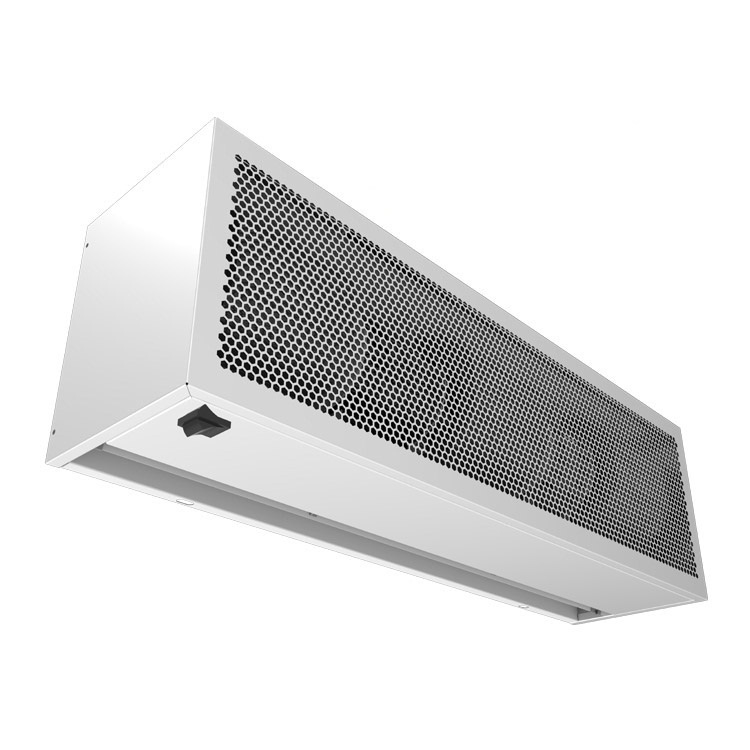
Choosing the wrong unit guarantees failure. If the air velocity cannot reach the floor, the seal breaks. External winds will easily punch through weak airflow. Proper specification requires matching the blower capacity to the exact opening height and local wind loads.
Standard docks usually measure between 12 and 14 feet high. For these, standard industrial models balance high airflow with moderate energy use. They handle typical daily breezes effortlessly. However, extreme industrial applications demand much more power.
Extreme openings stretch from 17 feet up to 50 feet high. These massive doors expose the facility to severe weather. Here, you need heavy-duty solutions like the FM-50 series. These extreme units are precisely engineered to maintain a coherent, unbroken air seal against exterior wind gusts up to 30 mph. They use specialized nozzle designs to push dense air volumes all the way to the concrete.
Equipment Sizing Reference Chart | |||
Application Type | Max Door Height | Wind Resistance Capacity | Typical Use Case |
|---|---|---|---|
Standard Commercial | Up to 10 ft | Low (< 10 mph) | Employee entries, retail doors |
Standard Industrial | 12 ft - 14 ft | Moderate (10 - 15 mph) | Standard loading docks, internal zones |
Extreme Heavy-Duty | 17 ft - 50 ft | High (Up to 30 mph) | Shipyards, aerospace hangars, massive distribution hubs |
Motor selection dictates long-term efficiency. Traditional PSC (Permanent Split Capacitor) motors consume more electricity and ramp up slowly. Warehouses should heavily favor EC (Electronically Commutated) motors. EC technology delivers far greater energy efficiency. More importantly, an EC motor boasts a full-speed start response time of less than 1 second. When a fast roller door triggers, the barrier forms instantly before external air intrudes.
Heavy industrial use destroys fragile mechanical linkages. We strongly recommend direct-drive systems over traditional belt-driven models. Direct-drive connects the fan directly to the motor shaft. It eliminates coupling misalignment entirely. Your maintenance team will never have to perform routine belt replacements.
You must also specify models built for easy servicing. Request units featuring distinct top and bottom access panels. Maintenance managers can easily service blowers and clean internal components. They can do this safely from a lift without ever lowering the entire heavy unit from the wall.
Not all doorways simply separate air. Some must actively warm the incoming breeze to protect staff working nearby. Choosing the right thermal add-on improves localized comfort and ensures specific operational needs are met.
Ambient units draw existing room air and accelerate it downward. They contain no internal heating elements. These are best for internal temperature zoning, cold storage separation, or pure pest and dust control. Because ambient air separation is often sufficient inside the building, these models boast the highest ROI and the absolute lowest operating costs.
Exterior loading docks face brutal winter winds. Unheated air blown at high speeds can feel uncomfortably cold to dock workers. You solve this using direct gas, indirect gas, or electric heating coils. These elements actively temper the cold drafts entering the dock. This maintains employee comfort. It also prevents dangerous winter freezing and ice slicks from forming near the metal dock plates.
Electric coils consume significant high-voltage power. A smarter, highly efficient choice exists for facilities equipped with existing boiler systems. A water heated air curtain taps directly into the building’s infrastructure. It utilizes the facility's hot water supply to temper the heavy air stream. This configuration drastically lowers operational costs compared to electric alternatives while providing robust, consistent warmth at the threshold.
Facility managers carry immense liability regarding environmental health and safety. Beyond thermal regulation, downward airflow mitigates critical warehouse risks. It serves as an active shield against biological and physical hazards.
Warehouses situated near fields or water constantly battle flying insects. Bug zappers and chemicals are messy and hazardous. High-velocity air creates a dense environment where flying insects simply cannot survive or pass through. Facilities report reducing pest presence by up to 67% without using any chemical sprays. This barrier is absolutely essential for food-grade processing facilities requiring strict NSF-37 certification.
Heavy rain and blowing snow create severe liabilities at loading docks. When wet weather blows onto smooth concrete loading zones, slip-and-fall hazards multiply instantly. Forklift tires lose traction, risking fatal collisions or dropped loads. A powerful downward blast actively repels rain drops and snow flakes. It keeps the critical first 15 feet of your dock perfectly dry during storms.
Humid environments and coastal distribution centers eat through standard steel quickly. Salty air causes rapid rusting, destroying equipment within months. For these harsh locations, you must advise the specification of AMCA-certified units. Demand all-welded construction. Choose either heavy powder-coated finishes or marine-grade stainless steel. This specifically reduces rust probability and ensures decades of safe overhead operation.
An invisible downward barrier is far more than a simple HVAC accessory. It serves as a core material handling and facility protection asset. It slashes energy waste, accelerates forklift traffic, and actively defends your inventory from pests and moisture.
To upgrade your facility properly, follow these critical next steps:
Audit your worst doors: Identify the specific doorways experiencing the most drafts, bug infiltrations, or workflow bottlenecks.
Record structural data: Measure the exact opening height and width, and note the available voltage nearby.
Identify primary pain points: Determine if your goal is stopping 30 mph winds, tempering winter cold, or securing food-grade sanitation.
Engage an expert: Consult a specialized manufacturer to perform a computational fluid dynamics (CFD) sizing analysis and generate a localized ROI calculation.
A: They are typically integrated with a heavy-duty roller or plunger door switch. The unit activates instantly—usually in under 1 second—only when the mechanical door begins to open. Once the door closes fully, the blower shuts down automatically to conserve power.
A: No. They are meant to complement physical doors, not replace them. They provide an impenetrable barrier during active working hours when doors must remain open for traffic. Physical doors are still required to provide overnight security, lockdown capabilities, and static insulation when the facility is closed.
A: Heavy-duty models generate noticeable noise due to the high air velocity required to push air all the way to the floor. However, this sound is typically equivalent to standard warehouse background noise. Furthermore, the unit only generates noise during the brief periods when the physical door is open.


