


Views: 0 Author: Site Editor Publish Time: 2026-09-03 Origin: Site


Installing climate control equipment correctly determines its ultimate success. Placing an Air Curtain at the wrong height immediately voids its primary benefits. You risk compromised climate separation, wasted HVAC energy, and failed pest exclusion.
Many facility managers struggle during the installation planning phase. They often mount units too high just to clear aesthetic obstacles. Others severely underestimate the velocity required to maintain a protective seal down at floor level. These common mistakes lead to poor performance and customer discomfort.
We will fix this knowledge gap today. You need a definitive framework for matching doorway dimensions and environmental factors to precise equipment specifications. Read on to discover exactly how to evaluate your space and secure optimal performance.
Fluid dynamics govern how a barrier of moving air behaves. Air velocity drops significantly the further it travels from the discharge nozzle. We call this phenomenon velocity decay. Equipment must push air hard enough to overcome this natural decay. To remain effective, the airstream must maintain a specific minimum velocity in feet per minute (fpm) by the time it reaches the floor.
Velocity decay happens because the moving airstream constantly drags surrounding ambient air along for the ride. This mixing process saps energy from the main jet. If you mount a unit too high, the jet loses its structural integrity before touching the ground. You end up blowing a weak breeze rather than establishing a solid barrier.
A successful installation relies on the physical "split" at the floor level. The airstream must strike the floor surface with enough force to divide evenly. One half rolls inward, while the other half rolls outward. This dynamic split creates the actual seal. It actively pushes away flying insects, dust, and unconditioned outdoor air. If the air merely drifts down to the floor, pests will simply fly under the weak draft.
Many people confuse air volume with air velocity. High volume, measured in cubic feet per minute (CFM), dictates the sheer amount of air moving through the system. Velocity dictates the speed and penetrating power of that air. You can have massive volume pouring out of a wide nozzle, but without sufficient velocity, the air will never span the full door height. Proper mounting guarantees you harness both metrics effectively.
Commercial buildings feature distinct zones requiring different approaches to climate control. Customer-facing entrances demand a delicate balance. You must maintain an effective thermal barrier without creating excessive noise or disruptive drafts for passing guests. Most retail spaces, restaurants, and office building entrances feature doors between seven and ten feet tall.
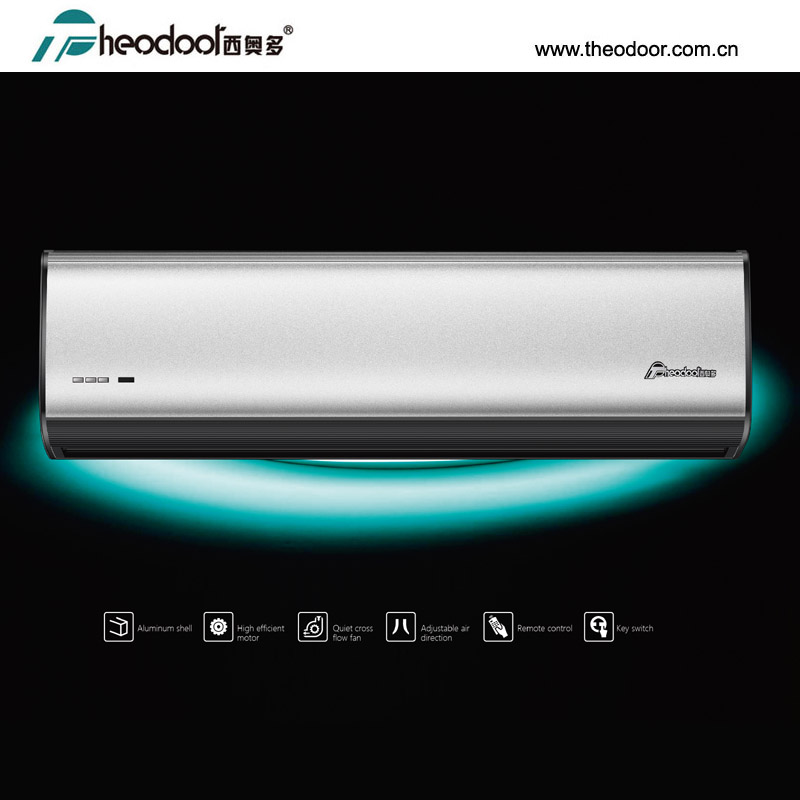
For these standard environments, engineers usually recommend a cross flow air curtain. This technology uses a long, cylindrical impeller to draw air in and push it out continuously across the entire width of the unit. The design delivers a highly uniform, smooth sheet of air. It operates with a much lower acoustic profile compared to industrial fans. Customers walking underneath feel a pleasant breeze rather than aggressive wind.
Service and receiving doors present a different challenge entirely. These large shipping bays often stretch from ten to fourteen feet or more in height. A standard commercial unit would fail instantly here. The sheer vertical distance requires industrial-grade velocity to prevent severe velocity decay. Manufacturers utilize heavy-duty centrifugal fans to push the airstream over these massive vertical drops.
| Door Type & Environment | Standard Height Range | Recommended Technology | Primary Application Focus |
|---|---|---|---|
| Retail / Restaurant Fronts | 7 to 10 feet | Cross Flow Technology | Customer comfort, low noise, insect control |
| Office Lobbies | 8 to 12 feet | Cross Flow or Light Centrifugal | Aesthetic integration, draft prevention |
| Supermarket Receiving Bays | 10 to 14 feet | Centrifugal Fans | Thermal separation, heavy pest exclusion |
| Industrial Warehouses | 14+ feet | Heavy-Duty Centrifugal | Stopping high wind loads, forklift clearance |
Selecting the correct model requires aligning theoretical specifications with physical reality. Manufacturers provide performance charts mapping velocity against distance. You must read these charts carefully. Locate your exact true mounting height on the graph. Then, verify the corresponding terminal velocity at the floor level. The fpm must be strong enough to create the necessary outward split.
You will often face trade-offs between aesthetic design and brute performance. High-end retail spaces frequently request recessed, in-ceiling models to maintain a clean architectural look. While visually pleasing, you must evaluate recessed models carefully. A recessed commercial entrance air curtain still needs to project air from a higher elevation point. The unit must possess the blower capacity to bridge the extra gap between the false ceiling and the actual door header.
Your next steps require precise data gathering. Grab a tape measure and record the exact dimensions of your opening. Assess your HVAC system to determine if your building operates under negative pressure. Check the prevailing wind direction outside the specific entrance. Once you have this data, consult with a qualified application engineer. They can review your true mounting height and recommend a tailored solution.
We must treat this equipment as an engineered climate solution, not just a glorified ceiling fan. Physics dictates performance, and precision matters during the planning phase. Getting the installation right on day one guarantees long-term operational success.
Precise mounting height serves as the foundational metric for selecting your unit. Follow these final action steps to maximize your investment:
A: Yes, vertical mounting is possible when overhead clearance is non-existent. However, this orientation inverts your height and width constraints. The unit must blow air horizontally across the entire width of the doorway. Side-drafts often struggle against strong winds, and you may need dual units (one on each side) to successfully seal wider entrances.
A: Never mount the unit flush against a high ceiling if it exceeds the manufacturer's recommended height. Instead, use extension brackets or threaded drop-rods to suspend the unit. This brings the discharge nozzle down to the correct functional height directly above the door header, preventing premature velocity decay.
A: No. Motor capacity and nozzle design have strict physical limits. Running a smaller unit at maximum speed will not magically bridge a taller distance; it will simply create excessive noise while failing to seal the floor. Always purchase a unit specifically engineered and rated for your actual mounted height.


