


Views: 0 Author: Site Editor Publish Time: 2026-08-21 Origin: Site


Upgrading your home's water heating system brings significant energy savings. However, navigating the switch to an All in One Heat Pump often leaves homeowners baffled by capacity choices. Selecting the correct tank size is arguably the most critical decision you will make during this upgrade. Choose poorly, and your daily routine suffers.
The problem is straightforward. Under-sizing your unit to a 200L model risks cold showers during peak morning usage. Conversely, over-sizing to a 300L model increases your upfront purchase costs. It also demands a much larger spatial footprint inside your home. Homeowners need clear, actionable guidance to navigate this balance.
This guide provides a strictly criteria-based framework to help you choose the exact capacity you need. You will learn how to evaluate your real household demand. We will explore climate conditions and installation realities. By the end, you will confidently select the right system for your specific lifestyle.
Capacity vs. Headcount: 200L typically serves 2–4 people; 300L is engineered for 4–6 people or households with overlapping morning routines.
Recovery Reality: A heat pump water heater recovers slower than traditional gas or electric systems; larger tanks (300L) act as necessary "thermal buffers" against high demand.
Spatial Limits: 300L models require significantly more vertical clearance and structural support; tight spaces may necessitate downgrading to 200L or switching to a Split Type Heat Pump.
Efficiency Tactics: Sizing up to 300L can allow for "load shifting" (running the unit only during off-peak energy rates or peak solar hours).
Choosing between capacities starts with understanding physical dimensions. A larger tank stores more water, but it also claims more real estate. Homeowners often underestimate the physical bulk of modern water heating systems. High-density insulation makes these units wider and heavier than older electric models.
Baseline Comparison Between Standard 200L and 300L Models
Specification | 200L Model (Average) | 300L Model (Average) |
|---|---|---|
Height | 1.5 to 1.7 meters | 1.8 to 2.1 meters |
Diameter | 600 mm | 650 mm to 700 mm |
Dry Weight | 90 kg | 120 kg |
Wet Weight (Full) | Approx. 290 kg | Approx. 420 kg |
The wet weight difference is substantial. A full 300L tank demands verified floor load-bearing capacity. Standard concrete garage floors handle this weight easily. However, elevated utility closets or older wooden floor joists might buckle under 420 kilograms. You must verify structural integrity before committing to the larger size.
Airflow requirements also dictate your choice. These systems extract ambient heat to warm your water. They need substantial air volume to operate efficiently. A cramped utility closet chokes the system. It suffers from the "cold-room effect". The unit continuously chills the same small pocket of air, tanking its Coefficient of Performance (COP). A 300L unit pulls more heat and requires larger room volumes or louvered doors to breathe properly.
Finally, consider the baseline cost delta. The price gap between these two sizes typically ranges from 20% to 35%. This gap affects your ROI timelines. You pay more upfront for the 300L, but you gain comfort and advanced energy management options. Set realistic expectations for your payback period based on your local energy rates.
Many buyers simply count family members to pick a tank size. This method is flawed. You must assess peak demand instead. The "First Hour Rating" (FHR) framework offers a better metric. FHR measures how many simultaneous fixtures you can run before the water turns cold. Running two showers while operating a dishwasher matters far more than your total daily water volume.
A standard shower head uses roughly 9 liters per minute. Two family members taking simultaneous 10-minute showers consume 180 liters. A 200L tank will nearly deplete in this scenario. If a third person steps into the shower shortly after, they will face cold water. A Heat Pump Water Heater recovers slowly. It cannot instantly reheat the incoming cold water like a massive gas burner.
Handling demand swings requires strategy. Consider households with fluctuating usage. Frequent overnight guests or deep-soak bathtubs drain tanks rapidly. When demand spikes, small tanks panic. The system triggers a backup electric resistance element to catch up. This element consumes massive amounts of electricity. It destroys your intended energy savings. A 300L system prevents this trigger. It holds enough hot water to absorb demand spikes naturally.
Your choice ultimately forces behavioral adjustments. Choosing a 200L system for a medium family requires strict coordination. You must space out your showers. One person showers at night, while another showers in the morning. Choosing the 300L model offers "gas-like" convenience. You avoid scheduling friction and enjoy hot water on demand.
Install low-flow showerheads in all bathrooms. They reduce peak water draw by up to 30%. This simple upgrade helps a smaller tank perform like a larger one during busy mornings.
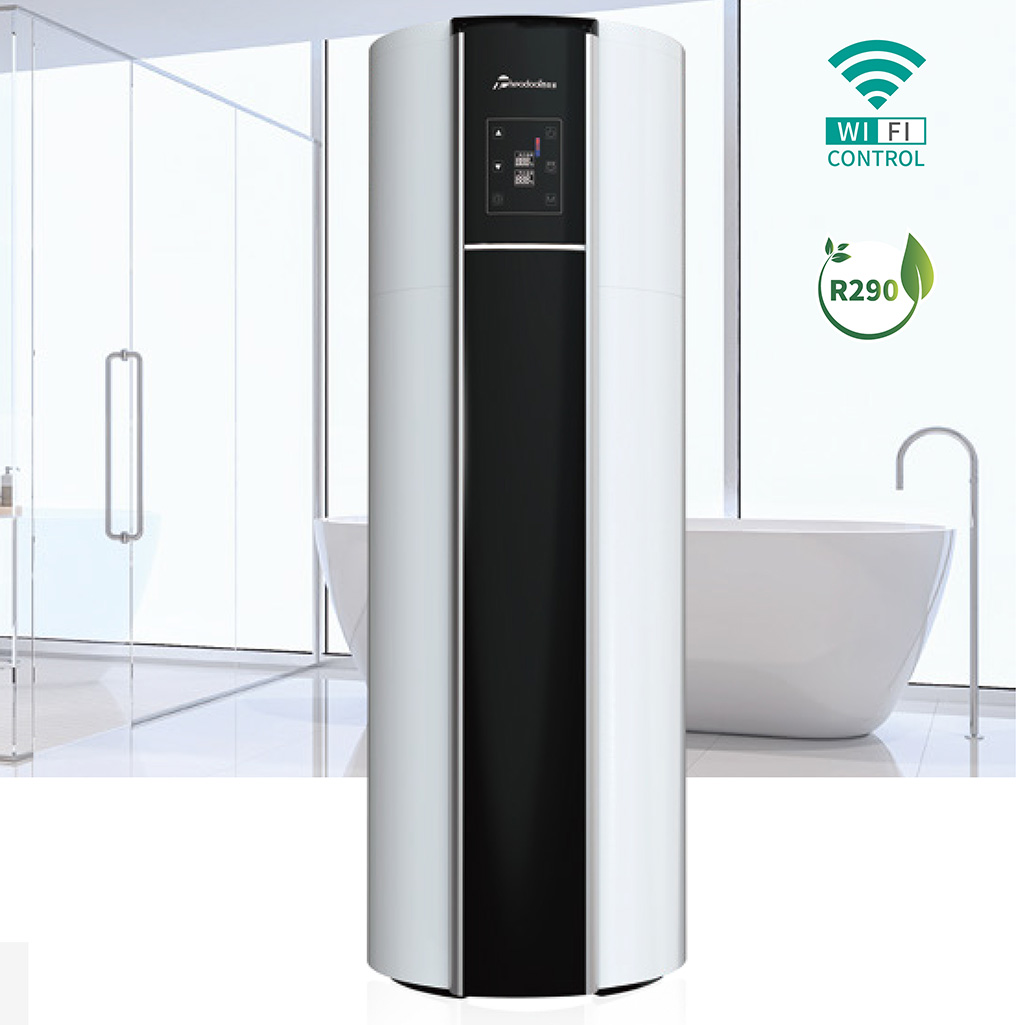
Your local climate drastically influences system performance. All heat pumps lose heating efficiency in colder ambient air. They extract heat energy from the surrounding environment. When the air is cold, less heat energy is available. The compressor must work harder and longer to reach your target water temperature.
We strongly recommend the 300L size for colder regions. This rule also applies if you install the unit in an unheated basement or garage. Slower cold-weather recovery means a larger stored volume is necessary. The larger tank acts as a critical cold climate buffer. You rely on the stored volume to get through the day, rather than relying on fast recovery.
Proper sizing also protects your compressor lifespan. Small tanks deplete quickly and trigger the system frequently. This rapid turning on and off is called "short-cycling". Short-cycling accelerates wear and tear on mechanical components. A larger tank cycles less frequently. It heats a massive batch of water once, reducing mechanical strain and extending the compressor's operational life.
Buyers in freezing climates often choose small tanks to save money. Winter arrives, recovery times double, and the backup heater runs constantly. The initial savings vanish through inflated winter electricity bills.
Sometimes, your home makes the decision for you. Physical space constraints often override peak demand calculations. Vertical clearance is a primary hurdle. A 300L unit easily reaches 2 meters in height. You cannot simply slide it into a tight space. You must leave room above the unit for filter maintenance. You also need overhead space if you plan to install ducting to vent the exhaust air.
Verify your ceiling heights before purchasing. Standard basements might accommodate the height, but retrofitted utility closets often fall short. An All In One Heat Pump requires precise clearances on all sides to function optimally and safely.
What happens if you need 300L of water but lack the indoor footprint? You pivot your strategy. Introduce the split system alternative. Switching to a Split Type Heat Pump solves severe indoor space limitations. A split system places the bulky compressor outside your home. Only the storage tank remains indoors. This setup reduces indoor noise and drastically lowers vertical clearance requirements.
Water holds heat exceptionally well. This property allows a well-insulated water tank to act as a "thermal battery". You can store cheap energy as hot water and use it later. This load-shifting strategy accelerates your ROI significantly.
Solar PV integration perfectly highlights this strategy. If you have solar panels on your roof, an oversized 300L tank is highly recommended. You program the system to heat water during peak solar hours (usually midday). The system absorbs excess daytime solar energy to heat water practically for free. The heavy insulation keeps the water hot until your family needs it in the evening. A 200L tank simply cannot store enough energy to maximize this free solar generation.
Time-of-Use (TOU) tariffs offer another financial advantage. Many grid providers charge expensive rates during early evening peaks. They offer massive discounts during overnight off-peak hours. You can program a 300L tank to heat exclusively overnight on cheap grid rates. It stores enough volume to coast completely through the next day's expensive pricing periods. A 200L tank lacks the volume to coast through a full day of family usage. It will inevitably trigger during expensive peak hours.
Review the criteria below to finalize your capacity decision. Match your household characteristics to the appropriate size.
Opt for the 200L Model If:
Your household consists of 1 to 3 people.
Family members are willing to stagger showers throughout the day.
You rarely use large soaking bathtubs.
Your installation area is a constrained interior space with standard climate control.
You do not have a Time-of-Use tariff or a large solar PV system.
Opt for the 300L Model If:
Your household consists of 4 or more people.
Your home features large soaking tubs or high-flow rain showers.
Morning routines overlap, requiring simultaneous hot water usage.
You plan to install the unit in a colder climate or an unheated garage.
You want to optimize TOU energy rates or integrate heavily with solar PV.
Next-Step Actions: Grab a tape measure. Accurately measure your intended installation space, including vertical clearance. Next, check your electrical panel capacity to ensure it supports the new unit's amperage. Finally, consult with a certified installer to confirm your room meets airflow calculations.
Selecting between a 200L and a 300L unit requires balancing upfront costs, physical space, and your daily lifestyle habits. There is no universal correct answer, only the correct answer for your specific home environment. You must respect the slower recovery realities of modern high-efficiency systems.
Over-sizing to a 300L model generally proves to be the safer long-term investment. It secures your comfort during heavy usage days. It also unlocks advanced off-peak energy strategies like solar load shifting. Provided your home has the physical space and structural support, the larger tank delivers peace of mind.
Do not finalize your purchase blindly. Download a detailed product specification sheet to verify exact dimensions. Use an online sizing calculator tailored to your climate zone. Reach out to a technical consultant to guarantee your new system matches your home's unique demands.
A: Yes, but it requires strict shower scheduling. You cannot run multiple showers simultaneously. During heavy use, the system will likely rely on the less-efficient backup heating element, which temporarily reduces your overall energy savings.
A: From a completely cold start at standard ambient temperatures (20°C), a 200L tank typically takes 3 to 4 hours to reach optimal temperature. A 300L tank may take 5 to 6 hours. Winter temperatures will extend both recovery times considerably.
A: Consider a split system when you face severe indoor space limitations or low ceiling heights. It is also ideal if you want to completely eliminate indoor compressor noise, as the noisy components are mounted outside the home.
A: Technically, a larger surface area allows slightly more standby heat loss. However, modern high-density insulation keeps these losses negligible. The active energy savings gained from load shifting and avoiding the backup element far outweigh any minor standby losses.


