


Views: 0 Author: Site Editor Publish Time: 2026-05-19 Origin: Site


Building entrances face immense pressure from outdoor climates. Relying on basic doors often fails to maintain indoor boundaries. Selecting the wrong air curtain technology compromises indoor air quality. It leads to excessive energy waste. Employees suffer from uncomfortable drafts daily. Facility managers face a difficult choice. You must balance strict acoustic requirements against aerodynamic reach. You need a reliable climate seal.
This creates a core dilemma. Do you choose the quiet, uniform laminar flow of a cross flow unit? Or do you need the deep-penetrating power of a centrifugal system? Both models serve entirely different building dynamics.
We present an evidence-based technical evaluation. You will discover the exact physics driving these fans. We evaluate essential ground velocity targets and strict compliance standards. We outline physical installation realities and maintenance needs. This guide equips you to make an authoritative choice for your facility entrance.
Cross Flow: Best for commercial applications under 3.5 meters. Delivers uniform, quiet laminar flow with lower installation and maintenance overhead.
Centrifugal: Engineered for industrial and tall commercial doors (4–8 meters). Produces high static pressure to combat strong wind loads and chimney effects.
The Deciding Metric: Evaluation should prioritize maintaining a ground-level air velocity threshold (typically 2.0–3.0 m/s) rather than relying solely on total CFM (Cubic Feet per Minute) output.
To make an informed decision, we must understand the distinct physics separating these systems. The internal fan design dictates how air behaves as it exits the nozzle.
A cross flow air curtain operates using a unique tangential process. Engineers often refer to the "vortex tongue" mechanism. This aerodynamic phenomenon defines the operational core. Air enters the unit and passes vertically through the fan axis. It literally travels through the rotating blades twice. This dual-pass action stabilizes the turbulent intake air. It transforms irregular drafts into a continuous, uninterrupted band of air.
The discharge spans the entire nozzle length uniformly. You do not experience dead spots. You avoid high-pressure spikes which often cause erratic airflow. The system generates a wide, smooth barrier. This barrier glides down toward the floor smoothly. It acts as an invisible, highly efficient shield.
The centrifugal mechanism operates differently. It utilizes a 90-degree radial acceleration process. Air enters the fan center from the sides. The rotating impeller grabs this air aggressively. It then pushes the air outward radially into a dedicated plenum chamber.
This precise physical action converts kinetic energy into massive static pressure. The high pressure builds inside the internal housing. It forces air down through the discharge nozzle at high velocities. This intense pressure makes a centrifugal air curtain incredibly powerful. It punches through severe environmental resistance. It effectively stops harsh outdoor winds from entering your facility.
We must acknowledge a common engineering vulnerability. Centrifugal units rely heavily on internal pressure redistribution. The high-pressure air must spread evenly across a long discharge nozzle. Poorly designed models struggle to maintain this equilibrium. They create microscopic velocity gaps along the airflow path.
These gaps introduce severe operational risks. They can trigger a Venturi effect near the doorway. The uneven barrier inadvertently draws outside air inward. Contaminants and unconditioned air bypass the shield entirely. You must ensure perfect airflow balance to avoid this issue. High-quality manufacturing standards mitigate this risk significantly.
Evaluating these units requires measurable data. Vague claims about power or efficiency lack engineering credibility. A true air curtain comparison relies on verifiable performance metrics. You must test the physical limitations of each unit.
Total CFM tells an incomplete story. Performance depends entirely on ground-level air velocity. The barrier must remain intact right at the floor threshold. If the air breaks before hitting the ground, the entire system fails.
We rely on specific engineering targets for different applications. You must match your equipment to these strict thresholds:
Application Type | Required Ground Velocity Target | Primary Objective |
|---|---|---|
Climate & Energy Control | ~2.0–2.5 m/s | Maintain indoor temperatures and offset outdoor thermal loads. |
Insect & Debris Control | ~2.5–3.0 m/s | Block flying insects, dust, and airborne particulates effectively. |
Cold Storage Environments | ≥2.5 m/s | Prevent internal frosting, ice buildup, and dangerous floor condensation. |
Uniformity determines sealing efficiency. Cross flow fans maintain exceptionally high laminar uniformity. The air drops in a straight, parallel stream. This smooth descent seals standard commercial doorways perfectly. The barrier acts like a solid pane of glass.
Centrifugal systems behave differently. They create turbulent, high-velocity air streams. Engineers design them for deep penetration. They prioritize sheer force over smooth sealing. The barrier acts like a rigid wall pushing back against wind. It handles chaotic outdoor environments easily.
Noise remains a major compromise in building design. You must evaluate the acoustic footprint carefully. Cross flow units undergo rigorous optimization for front-of-house applications. They operate quietly. They often maintain noise levels at or below 55–60 dB(A). Visitors rarely notice their operation. To put this into perspective, 55 dB(A) resembles the hum of a quiet refrigerator.
Centrifugal units inherently generate higher decibel levels. Heavy turbulence and extreme static pressure cause this elevated noise. These fans move massive air volumes forcefully. The mechanical sound travels further. They remain fundamentally unsuitable for quiet retail stores or sensitive healthcare lobbies.
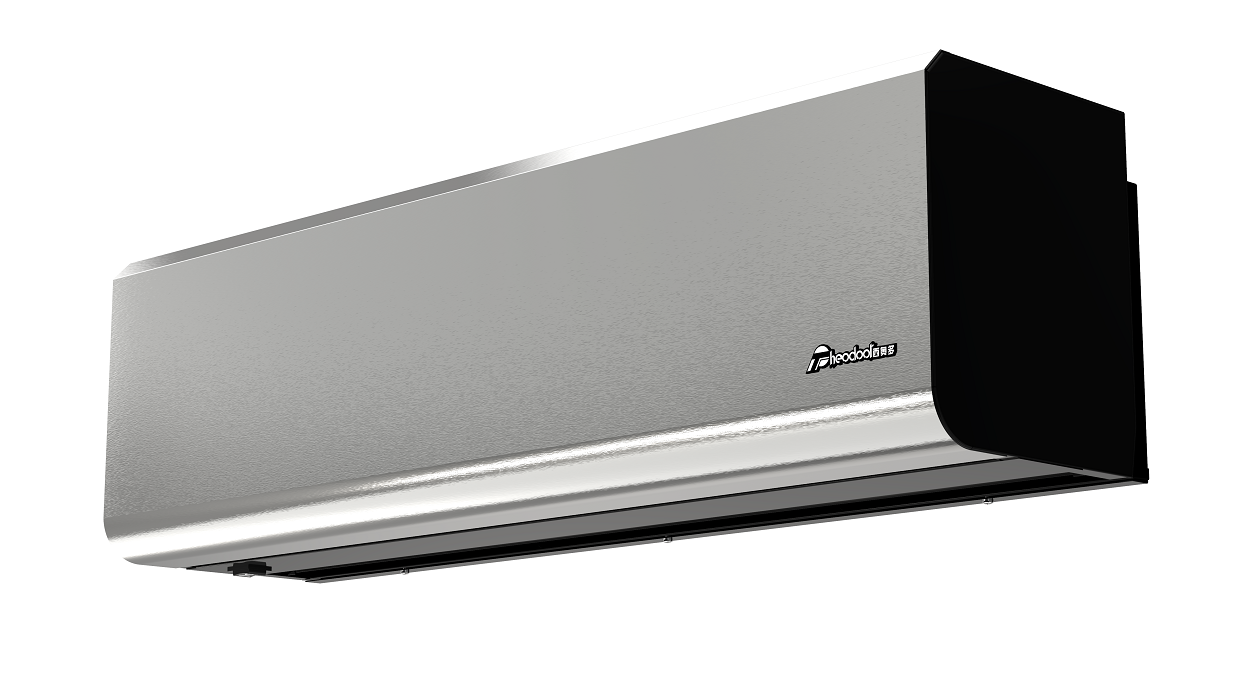
Different building sectors demand specific operational profiles. We match the technology directly to your architectural environment.
Commercial sectors prioritize customer experience. Architects demand slim aesthetics. Building managers require low noise levels. Facilities often need integrated indoor air quality (IAQ) filtering. These environments usually feature standard door heights ranging from 2.3 to 3.5 meters.
Cross flow technology dominates this space. The compact cylinder design fits tight spaces effortlessly. You can even utilize recessed installations. Recessed models hide the unit entirely within the ceiling. Architectural aesthetics remain pristine. The quiet operation protects the ambient environment. Retail shoppers and hospital patients experience no acoustic disruptions.
Logistics environments present brutal climate challenges. An industrial air curtain must perform under extreme stress. Distribution centers feature massive loading docks. Hangar doors frequently range from 4 to 8 meters in height.
You need centrifugal technology here. Heavy wind loads constantly batter these large openings. Massive internal spaces create strong stack and chimney effects. The building literally sucks outdoor air inside. Forklifts constantly enter and exit these zones. A weak barrier collapses instantly. Only high-velocity static pressure can overcome these intense forces. The turbulent downward blast prevents climate loss. It secures the vast warehouse interior against relentless outdoor elements.
Building codes dictate equipment selection. You cannot guess compliance. You must meet established North American and international standards.
Modern energy codes strictly regulate building envelopes. The IECC (International Energy Conservation Code) provides clear mandates. High-performance models can legally replace bulky, space-consuming structural vestibules. You avoid constructing restrictive double-door glass boxes.
However, you must prove compliance. The equipment must pass strict testing standards like AMCA 220. The unit must hit the critical 2.0 m/s ground velocity minimum. If it fails this test, inspectors will reject the installation. Proper selection ensures you meet the legal energy code alternatives securely.
Food service environments face intense sanitation scrutiny. NSF/ANSI 37 establishes specific operational thresholds for commercial kitchens. You must hit exact air speeds to block pests.
The code breaks down requirements by entrance type:
Customer Entries: These doorways require a minimum velocity of 600 fpm. Inspectors measure this exactly 3 feet from the floor.
Service and Delivery Entries: These doors face higher contamination risks. They require a much stricter 1,600 fpm velocity. This intense speed effectively blocks flying insects from penetrating the loading zones.
These legal codes force specific equipment choices. You must evaluate your door type carefully. Taller delivery doors demand extreme power. You often need a centrifugal unit to reliably hit the 1,600 fpm threshold. Weaker fans will fail the inspection.
Conversely, customer-facing entrances remain easier to secure. A cross flow unit easily handles the 600 fpm requirement. It meets the code while maintaining a quiet, pleasant lobby environment.
Physical deployment introduces specific engineering challenges. You must prepare for distinct installation constraints and ongoing upkeep demands.
Hardware profiles vary drastically between the two technologies. You must plan your infrastructure accordingly.
Cross flow designs remain lightweight and manageable. They utilize simple single-motor configurations. They typically run on standard single-phase electrical power. Maintenance teams handle overhead installations quickly using basic scaffolding. You rarely need heavy lifting equipment.
Centrifugal systems present entirely different logistics. They feature heavy-duty, multi-motor systems. Wider doors dictate the motor count. You often see 2 to 4 motors per unit. This extreme weight requires forklift installation. The building facade may require extensive structural reinforcement to bear the sheer hanging weight safely. Furthermore, these massive motors demand dedicated 3-phase electrical drops.
Equipment longevity relies on consistent maintenance. Different fan types dictate different upkeep schedules.
Cross Flow Maintenance: These units require minimal ongoing upkeep. You should perform a basic annual motor check. Facilities staff simply complete a monthly exterior wipe-down. The clean environment keeps internal components safe.
Centrifugal Maintenance: Industrial facilities generate heavy airborne dust. You must clean the filters and grilles every two to three weeks. You cannot ignore the internal components. You must execute a deep clean of the scroll and impellers every six months. This rigorous schedule prevents dust buildup. It maintains the critical pressure efficiency.
Hardware efficiency matters, but smart operation matters more. Intelligent controls dictate your long-term operational success. They overshadow the baseline energy efficiency of the specific fan type.
You must implement advanced control systems. Door interlock switches ensure the unit only runs when necessary. Building Management System (BMS) scheduling prevents off-hours waste. BACnet integration allows remote monitoring. Adaptive speed controls adjust the fan RPM based on indoor and outdoor temperature deltas. These smart systems optimize your equipment seamlessly.
Selecting the appropriate doorway barrier requires clear engineering logic. We recommend following a structured decision framework.
Do not over-specify equipment: Let your specific doorway height and acoustic tolerance dictate your choice.
Commercial precision: If your door sits under 3.5 meters and you have low noise tolerance, select a cross flow unit.
Industrial durability: If your door exceeds 4 meters and faces high wind resistance, deploy a centrifugal system.
Next steps: Facility managers must conduct a physical anemometer test. Measure the air velocity at the floor threshold of your current doorways. Establish your exact m/s baseline before you request a new equipment quote.
A: It depends entirely on your climate and specific purpose. A heated air curtain effectively offsets cold drafts in harsh winter climates to ensure employee comfort. However, unheated models remain the standard choice for GCC and Middle East regions. You also use unheated units for cold storage facilities or pure insect control applications.
A: Generally no. You should only consider them if the doorway is unusually low, remaining well under 3.5 meters. Furthermore, the exterior wind loads must be minimal. A delicate laminar flow will typically break apart rapidly under the heavy environmental pressures common in industrial warehouse settings.
A: This problem usually occurs due to improper nozzle angling during setup. Internal pressure gaps can also cause a disruptive Venturi effect. Your installation team should angle the initial discharge approximately 0 to 10 degrees outward. This specific outward angle effectively counteracts internal draft creation and seals the opening.


