


Views: 0 Author: Site Editor Publish Time: 2026-09-18 Origin: Site


Cold storage facilities face constant battles every single day. They struggle against thermal transfer, moisture infiltration, and heavy energy loss at high-traffic doorways. Facility managers know this costly challenge intimately. Operations depend on rapid material movement alongside secure climate control. Poorly protected doorways leak massive amounts of chilled air outwards. This forces cooling compressors into expensive, nonstop overtime.
While an Industrial Air Curtain cannot completely replace a solid physical door, precision placement changes everything. Exact specification can reduce thermal infiltration by up to 80% during open-door cycles. This guide provides facility managers, engineers, and procurement teams with a strict, evidence-based framework. You will learn how to evaluate, size, and place air movement solutions properly. We will help you navigate AMCA/HEVAC-compliant performance standards to ensure maximum operational efficiency.
Thermodynamic realities govern every open doorway. You must understand the stack effect to control it. Cold, dry air is dense and heavy. Warm, humid ambient air is light and buoyant. When a barrier opens, these two distinct air masses collide immediately.
This collision creates the "split" phenomenon. Dense cold air escapes rapidly at the bottom of an unprotected doorway. Simultaneously, warm ambient air rushes in at the top. A poorly specified industrial air door fails because it cannot disrupt this powerful natural exchange.
The primary success criterion relies on kinetic energy. The generated air stream must possess enough kinetic energy to counter the pressure differential across the entire door height. Volume alone does not work. You need targeted, forceful air velocity.
Common Limitations to Acknowledge:
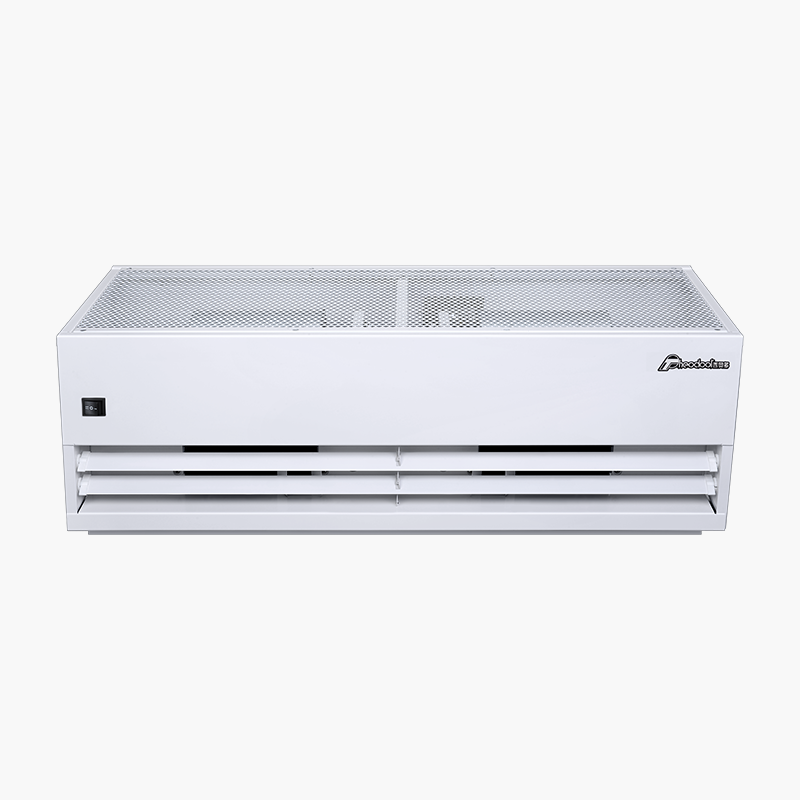
Location impacts survival in harsh industrial environments. Industry best practices strongly recommend the warm, ambient side rule. Mounting on the warm side ensures you draw in warmer, dryer air.
This approach prevents sudden condensation from freezing directly on fan blades. It keeps motors clear and discharge nozzles free of ice. This operational choice significantly extends equipment lifespan. It also reduces emergency maintenance frequency.
However, specific scenarios require the cold side exception. Facility managers consider cold-side mounting when strict spatial limitations exist outside. Certain pharmaceutical or food-grade internal washdown requirements also force this placement.
This exception carries a hefty tradeoff. Internal mounting requires specialized heated units. They need heavy-duty defrost cycles and totally enclosed motors to survive the freezing, harsh internal environment.
Regardless of the side, clearance requirements remain absolute. You must ensure unobstructed intake airflow. Placing a unit flush against a ceiling without sufficient top clearance throttles performance drastically.
Door height dictates your discharge velocity needs. You must evaluate the "throw distance" accurately. Standard commercial units fail miserably on massive industrial doors. They lack the blower strength required for tall openings.
You must specify a high pressure air curtain equipped with high-velocity blowers. The unit must maintain strict minimum floor-level velocity requirements. Most HEVAC standards demand at least 400 feet per minute (FPM) at the floor threshold to maintain the seal.
Your width overlap strategy is equally critical. The air stream must extend one to two inches beyond the door frame on both sides. Sizing a unit exactly to the opening often leaves small corner gaps. Air behaves fluidly, and it will bypass the curtain through these tiny, high-velocity thermal leaks.
For extra-wide openings, operators use tandem mounting. You link multiple continuous units together closely to form a single, unbroken wall of air.
Table: Minimum Floor Velocity Recommendations
| Door Height | Required Initial Velocity | Target Floor Velocity (FPM) |
|---|---|---|
| Up to 8 Feet | Medium | 400 FPM |
| 10 to 12 Feet | High | 400 - 450 FPM |
| 14+ Feet | Ultra-High | 500 FPM |
Deflection angle requires fine-tuning. Best practices suggest angling the discharge nozzles 5 to 15 degrees outward. Point them toward the warm, humid side. This angle deflects incoming atmospheric pressure effectively before it enters the threshold.
Moisture presents a severe operational hazard. When ambient humidity hits a sub-zero room, it immediately turns into thick fog. This creates dangerous visibility hazards for forklift drivers. Condensation then settles and forms floor ice, causing slip hazards.
Choosing between heated and unheated units solves this moisture problem. Engineers evaluate electrical, steam, or hot water heated options based on facility utilities. Evidence shows that heating the air stream slightly increases the local discharge temperature.
This minor temperature bump lowers the relative humidity of the air barrier itself. Lower humidity drastically reduces fog formation and prevents frost buildup at the threshold. A properly heated cold storage air curtain keeps floors dry and workers safe.
Control integrations maximize these benefits. You should tie the unit directly to automatic door switches. Plunger, magnetic, or optical sensors work perfectly. The goal is to ensure the motor reaches full RPM the exact second the door begins to part.
Technology cannot outwork bad physics. Building pressure imbalance remains a major risk. An air curtain cannot fix a warehouse suffering from severe negative pressure. You must address HVAC balancing and correct vacuum issues prior to installation.
Structural mounting realities demand serious engineering oversight. Industrial units weigh significantly more than retail models. Facility teams must evaluate wall integrity carefully. Follow these structural evaluation steps:
Maintenance accessibility often goes ignored during planning. You must place the unit where technicians can safely access intake grills. Routine cleaning is mandatory. Clogged filters and blocked grills immediately destroy air stream integrity and drop floor velocity to zero.
Procurement teams need strict shortlisting criteria to avoid inferior products. Always demand AMCA Certification. You must require third-party verified data following the AMCA 220 standard. This guarantees accurate airflow, velocity, and power consumption claims.
Motor durability dictates long-term reliability. Look for TEAO (Totally Enclosed Air Over) motors for dusty environments. If your facility follows strict FDA/USDA sanitation protocols, demand washdown-duty motors instead. These specialized motors survive aggressive chemical cleaning protocols without electrical failure.
Proper placement and exact sizing are non-negotiable elements. You need them to achieve true thermal separation in any cold storage facility. Sloppy installation wastes energy and creates dangerous moisture hazards.
Take action immediately by following these precise next steps:
A: No. They are designed to work in tandem. The air curtain protects the opening during transit, while the physical door seals the room during idle periods.
A: As close as physically possible to the top edge of the doorway. Any gap between the wall/frame and the unit allows thermal bypass.
A: Excessive velocity without proper angle adjustment can actually draw warm air into the cold room due to the Venturi effect. Precision tuning is required.


