


Views: 0 Author: Site Editor Publish Time: 2026-10-10 Origin: Site


Standard commercial air curtains often fail dramatically when applied to industrial heights. This mismatch leaves massive warehouse openings completely exposed to harsh external elements. Facilities constantly struggle to maintain stable indoor climates when these invisible barriers break down.
Specifying the wrong equipment based solely on door width ignores a critical structural metric: mounting height. Without adequate ground-level velocity, you waste significant energy while inviting pests and unconditioned air inside. Relying on inadequate retail-grade units ultimately puts your entire facility at compliance and operational risk.
This guide provides a definitive engineering framework for properly sizing high-clearance barriers. You will learn how to evaluate centrifugal fan requirements and address environmental wind loads. We will also identify exactly when vertical configurations become absolutely necessary for optimal thermal separation.
Air velocity dissipates exponentially as it travels away from the discharge nozzle. Standard retail units cannot bridge industrial distances effectively. The air stream simply breaks apart mid-air due to friction. Once the stream breaks, the opening loses all environmental protection.
Industry standards mandate a strict floor-level velocity rule for successful installations. The air must hit the floor with sufficient force to split the airstream. Engineers typically target a minimum of 400 to 600 Feet Per Minute (FPM) at the floor level. This forceful split creates a proper seal. It repels insects and prevents thermal infiltration simultaneously.
Choosing an undersized unit brings serious operational consequences. A weak barrier allows wind and cold air to rush inside freely. It creates a problematic "wind tunnel" effect across your warehouse floor. Facility HVAC systems then overwork massively to compensate for this lost conditioned air.
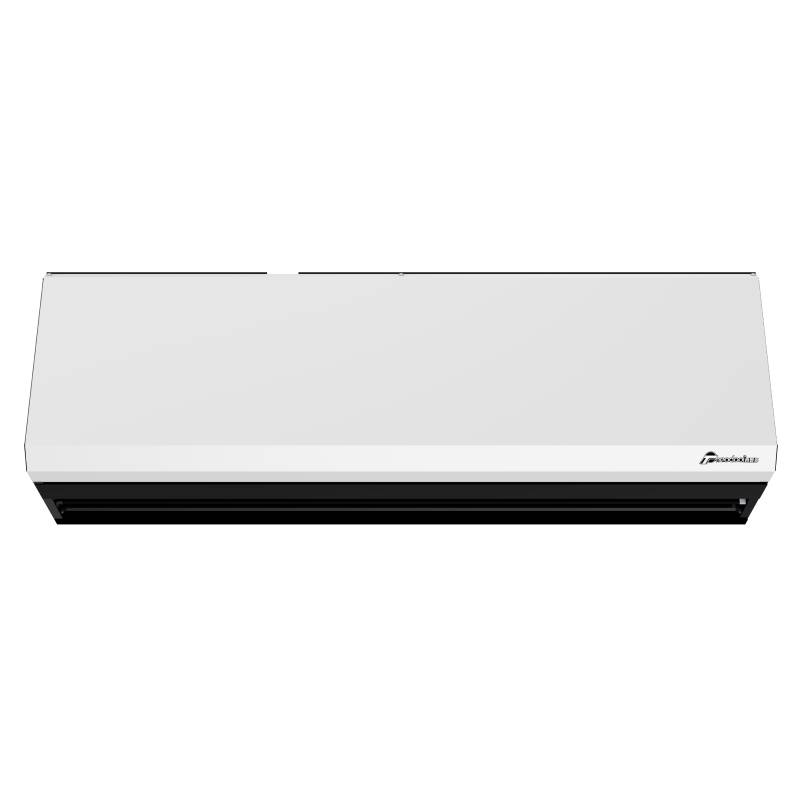
Tangential or cross-flow fans work very well for standard commercial doors. They offer low clearance profiles and broad discharge patterns. However, they produce significantly lower static pressure. They cannot push a rigid air stream down effectively past 10 to 12 feet. Their internal geometry simply lacks the compressive power required for tall openings.
This scenario is exactly where a heavy-duty Centrifugal Air Curtain becomes structurally necessary. Centrifugal blowers function completely differently from cross-flow fans. They pull air into a rigid scroll housing and compress it tightly. This specific action generates exceptionally high static pressure. They can push a highly concentrated air stream down 14, 20, or even 30 feet.
You need this intense kinetic energy for heavy industrial applications. The compressed stream acts like a solid, invisible wall. It resists external wind gusts and internal drafts effortlessly. Manufacturers design these blowers specifically for continuous duty in harsh environments.
| Height Range | Recommended Fan Type | Key Performance Characteristics |
|---|---|---|
| 0 - 10 ft | Cross-Flow / Tangential | Low static pressure, quieter operation, wide and soft airflow. |
| 10 - 12 ft | Heavy-Duty Cross-Flow | Upgraded motors, moderate static pressure, robust commercial use. |
| 12+ ft | Centrifugal Fan Systems | High static pressure, deep floor penetration, heavy industrial use. |
Specifying a reliable high door air curtain requires exact mathematical calculations. Guesswork leads directly to system failure and energy waste. Follow this strict four-step framework to ensure optimal thermal separation.
Sometimes, traditional top-mounting remains completely impossible. Overhead clearances might be restricted by oversized loading docks or large insulated roll-up doors. Heavy industrial crane rails can also block horizontal installations permanently. In these highly restricted scenarios, a vertical air curtain offers the perfect engineering solution.
You must evaluate the installation geometry carefully before proceeding. Unilateral mounting places a single unit on one side of the opening. We use this approach strictly for narrower passageways. Bilateral mounting places mirrored units on both sides of the door. You need this two-sided approach for wider industrial entryways.
These upright setups provide exact performance equivalence to overhead models. They achieve the same dense volumetric seal as top-mounted units. You simply need to calculate the horizontal throw distance correctly. The internal physics remain identical, just reoriented 90 degrees. Manufacturers use heavy-duty crash guards to protect these floor-mounted units from forklift damage.
Facilities frequently battle severe negative building pressure. Exhaust fans and natural thermal stack effects pull outside air inward aggressively. Warm air rises toward the roof and escapes, creating a vacuum at ground level. This vacuum effect can easily defeat a weak, undersized barrier. You must design your system proactively to fight these unseen forces.
External wind speeds at your specific facility location also matter deeply. High winds push directly against the generated air stream. A standard motor will fail completely against heavy seasonal gusts. Choosing a heavy-duty centrifugal air curtain helps overcome this intense external resistance.
We recommend a specific mitigation strategy for harsh, high-wind environments. You should always specify an up-sized motor to increase maximum FPM. Additionally, you must adjust the directional discharge angle. Tilting the nozzle 10 to 15 degrees outward pushes the air directly against incoming winds. This angled attack keeps the thermal barrier perfectly intact.
You must evaluate manufacturers rigorously before finalizing procurement. Start by checking foundational compliance and industry safety certifications. Look closely for AMCA-certified performance data to verify airflow claims. Verify UL listings for robust electrical safety. Require strict NSF compliance if you operate anywhere in the food or beverage sector.
Evaluating a unit's long-term operational efficiency is critical. Focus entirely on how the barrier reduces overall HVAC strain. Heavy-duty equipment demands a larger upfront capital investment. However, they deliver massive utility energy savings over their lifespan. A scientifically sized thermal barrier prevents conditioned air loss completely.
We strongly recommend consulting with a certified applications engineer as your next step. Ask them for a Computational Fluid Dynamics (CFD) analysis of your doorway. You should also request exact performance curve matching for your specific environment. This data-backed approach guarantees a successful and compliant installation.
The core relationship between mounting height, fan technology, and ground-level velocity is absolute. You cannot ignore basic physics when protecting large industrial openings. Specifying a proper centrifugal unit for high doors is never an optional upgrade. It remains a strict, foundational engineering requirement.
A properly calculated barrier prevents massive thermal loss and keeps unwanted pests outside. Retail-grade cross-flow technology simply cannot bridge these massive industrial distances. Investing in the right technology protects your building infrastructure.
Are you ready to secure your facility effectively? Submit your exact door dimensions, precise mounting height, and specific facility type to an engineering team today. They will provide a customized, data-backed sizing recommendation tailored for your unique application.
A: A centrifugal air curtain can push air effectively from 12 feet up to 30 feet or more. Heavy industrial models manage these massive distances easily. Maximum effective range depends heavily on the motor horsepower and local wind conditions. Proper nozzle adjustments ensure the air reaches the floor properly.
A: Yes, you can mount multiple smaller units next to each other. However, you must install them seamlessly side-by-side. You cannot leave any physical gaps between the individual chassis. Seamless mounting ensures an unbroken, continuous thermal barrier across the entire doorway width.
A: Yes, a vertical air curtain utilizes the exact same high-velocity centrifugal blowers. Manufacturers simply reorient the internal components. They engineer the external housing to support heavy vertical load bearing. The internal fan mechanics, static pressure generation, and overall airflow physics remain completely identical to horizontal models.
A: Your unit should overlap the door width by 3 to 6 inches on each side. This standard industry practice prevents environmental infiltration at the edges. An exact-width unit often allows cold air or pests to slip past the outer boundaries of the protective airstream.


