


Views: 0 Author: Site Editor Publish Time: 2026-09-22 Origin: Site


Frost and ice buildup near cold storage doors is not merely a routine maintenance headache. It acts as a direct driver of severe slip-and-fall liabilities, dangerous forklift accidents, and catastrophic evaporator coil freezing. This chronic operational issue occurs when warm, highly humid facility air violently infiltrates your sub-zero environment. Traditional plastic strip curtains often fail miserably in these demanding, high-traffic zones. Repeated physical damage, overlapping gaps, and persistently poor sealing leave massive, unhindered channels for airborne moisture to enter freely. Fortunately, modern facility managers can implement a sophisticated engineered solution to halt this infiltration effectively. Deploying an industrial air curtain creates an invisible, high-velocity aerodynamic seal straight across the doorway. In this comprehensive technical guide, you will discover the underlying mechanics of humidity deflection and temperature control. We will explore how to select the precise equipment required for overcoming extreme temperature differentials. You will also learn critical field-implementation steps to keep your facility safe, efficient, and completely ice-free.
Uncontrolled humidity triggers compounding financial penalties across modern cold storage and food processing facilities. Business operators frequently underestimate the extensive ripple effects of doorway condensation. Ice buildup creates massive safety and compliance risks on a daily basis. Forklifts quickly lose traction on slick concrete floors, leading to costly warehouse collisions and dropped pallets. OSHA regulations heavily penalize working environments where preventable slip-and-fall hazards exist. A single workplace injury caused by threshold ice can trigger intense regulatory scrutiny and devastating liability claims.
Furthermore, excess moisture inevitably leads to rapid equipment degradation. Humid ambient air naturally travels upward and instantly freezes onto cold evaporator coils located inside the freezer room. This thick frost layer acts as an aggressive thermal insulator, drastically reducing the heat transfer efficiency of the entire refrigeration system. Consequently, this dynamic forces the cooling system to run longer, highly energy-intensive defrost cycles. We routinely observe facility compressors working dangerously overtime just to handle the artificially inflated thermal load created by poor doorway sealing.
Product integrity also suffers heavily when moisture breaches the threshold. Frost actively accumulates directly on inventory boxes, sensitive goods, and plastic pallet wrapping. Thick ice completely obscures essential inventory barcodes, derailing automated scanning systems and disrupting logistics tracking. Ruined packaging inevitably leads to rejected shipments from stringent retail partners. You simply cannot afford to let doorway frost dictate your daily facility operations or compromise your highly regulated cold chain.
Understanding the exact physics of environmental separation remains critical for warehouse facility managers aiming to solve moisture issues. An Industrial Air Curtain generates a high-velocity jet of air over the doorway. This robust kinetic thermal barrier effectively blocks external ambient environments from mixing with refrigerated zones. It utilizes fan-driven momentum to build a rigid, invisible wall of moving air that physically repels cross-drafts.
The primary objective involves stopping the dangerous dew point shift directly at the opening. When a freezer door opens, a severe convection current forms almost instantly. Warm, humid air aggressively rushes in at the top of the opening due to thermal expansion. Simultaneously, cold, heavy air rapidly spills out at the floor level. The mechanical air stream directly deflects warm, moist ambient air away from the threshold. It aggressively pushes this airborne moisture back before it ever enters the cold room and reaches its dew point, completely halting the condensation cycle.
Effective frost mitigation requires highly precise fan calibration. You must meticulously balance both total air volume (CFM) and discharge nozzle velocity. Volume provides the necessary mass to resist sudden wind loads and facility pressure fluctuations. Velocity ensures the air stream maintains its structural integrity all the way down to the floor level. A weak or poorly calibrated air stream simply allows humidity to bleed right through the lower half of the doorway, creating dangerous floor ice that compromises employee safety.
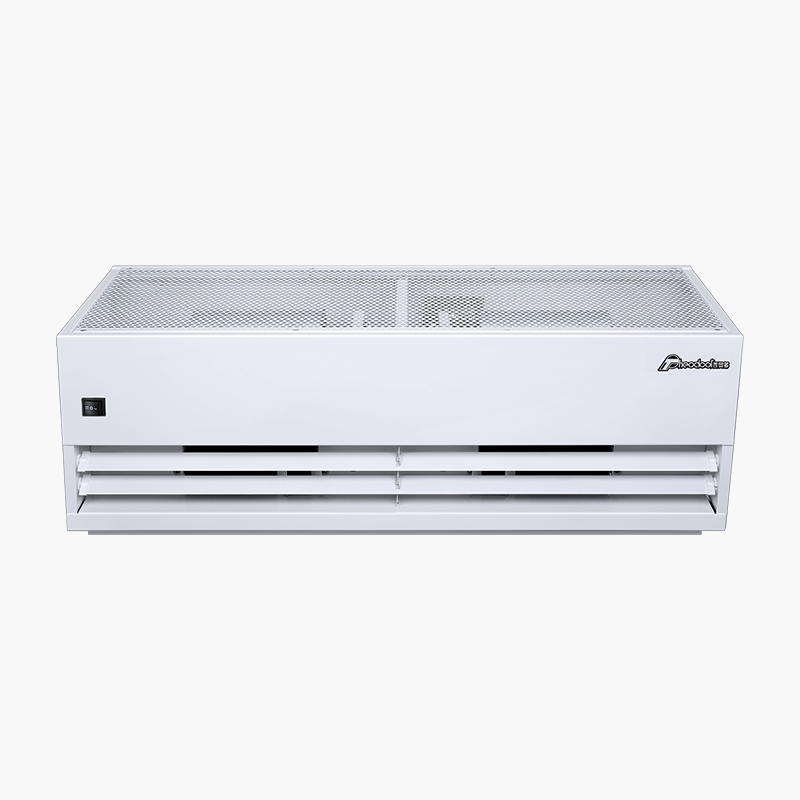
Not all aerodynamic barriers are engineered for the exact same thermal conditions. Facilities must match the equipment specifically to their unique temperature differentials and door dimensions. Attempting a one-size-fits-all approach inevitably leads to system failures and wasted capital.
We must carefully distinguish between unheated and heated models. Unheated units function perfectly for standard cooler applications operating above freezing temperatures. In these staging areas, the ambient facility air remains relatively dry and cool, reducing the risk of instantaneous freezing. However, true sub-zero freezer applications demand highly specialized configurations. A heated cold storage air curtain slightly warms the discharged air stream. This targeted heating prevents the rapidly moving air itself from causing localized condensation right at the cold threshold. Without this supplemental heat, the intense velocity can actually drop the localized temperature and generate thick mist, obstructing forklift visibility.
Facility managers must also choose between standard and extreme-duty blower profiles. Standard models generally suit low-clearance walk-in coolers where negative pressure remains negligible. Blast freezers and massive forklift doors present a drastically different engineering challenge. Extreme cold air is incredibly dense, creating an intense negative pressure vacuum at the floor level. A high pressure air curtain is absolutely necessary to forcefully punch through this dense pressure gradient. These advanced units feature robust centrifugal fans designed specifically to maintain barrier integrity against heavy drafts.
Table: Air Curtain Application Guide for Cold Storage Environments
| Equipment Profile | Primary Application Zone | Pressure Resistance Capability | Frost Mitigation Impact |
|---|---|---|---|
| Standard Unheated | Walk-in Coolers (Above Freezing) | Low to Moderate | Prevents basic condensation; unsuitable for deep freezes. |
| Standard Heated | Small Pedestrian Freezer Doors | Moderate | Stops misting at the threshold; prevents localized ice. |
| High-Velocity Centrifugal | Large Forklift Coolers | High (Handles heavy structural drafts) | Blocks massive volumes of warm air; keeps floors perfectly dry. |
| Heavy-Duty Heated | Blast Freezers & Sub-Zero Zones | Extreme (Combats severe negative pressure) | Deflects high humidity; actively prevents evaporator coil freezing. |
Selecting the optimal equipment requires rigorous technical evaluation and precise facility measurements. An improperly specified industrial air door will quickly fail to mitigate frost accumulation, leaving your infrastructure vulnerable. Consider these four pivotal criteria carefully before proceeding with any commercial installation.
Proper physical installation fundamentally separates successful deployments from complete operational failures. We frequently encounter several critical operational pitfalls in the field that compromise otherwise excellent environmental separation equipment.
The precise deflection angle remains the absolute most critical setup parameter. A very common failure point involves technicians pointing the discharge nozzles straight down toward the floor. Nozzles must be physically angled outward toward the warm side of the room. Typically, skilled installers set this angle meticulously between 10 to 20 degrees. This precise outward tilt successfully pushes incoming ambient moisture aggressively away from the threshold, letting the heavy refrigerated air stay inside.
Operating near heavily vibrating compressor walls introduces distinct mechanical risks. Heavy-duty blower motors operate intensely, and the sheer torque can compromise weak installations. Standard mounting bolts often vibrate loose over extended periods of operation. Furthermore, dust and debris present a persistent threat to maintaining consistent fan velocities.
No mechanical barrier eliminates 100% of moisture transfer entirely. However, a meticulously specified aerodynamic unit permanently shifts the operational balance in your favor. It completely transforms a hazardous, icy doorway into a manageable, highly safe threshold for your employees and material handling equipment. By leveraging high-velocity air streams, you protect your evaporator coils, safeguard your expensive inventory, and maintain strict regulatory compliance.
When evaluating diverse barrier options, always prioritize engineering manufacturers that offer advanced computational fluid dynamics (CFD) modeling. Demand specific CFM-to-door-height performance guarantees perfectly tailored for your distinct cold storage environments. Ensure the manufacturer deeply understands the nuances of dense, sub-zero pressure gradients.
For your immediate next steps, conduct a thorough facility audit. Measure your current door dimensions accurately from frame to frame. Track your daily doorway traffic frequency across all peak operating shifts. Finally, collaborate with your facility HVAC technicians to calculate any existing pressure differentials. Gather these hard metrics systematically before requesting technical quotes to ensure an exact, reliable equipment match.
A: No. They are complementary. The door provides the primary physical and thermal barrier, while the air curtain protects the opening during the necessary seconds the door is open for traffic.
A: It is highly discouraged. Installing the unit on the warm side of the opening is standard practice to prevent the motor and impellers from freezing and to utilize ambient air for the barrier.
A: While the electric or steam heaters in the unit draw power, the prevention of warm air infiltration typically saves significantly more in refrigeration compressor energy and deferred defrost cycle costs. Actual ROI depends on door cycle frequency.


