


Views: 0 Author: Site Editor Publish Time: 2026-10-08 Origin: Site


Loading bays represent a facility's most vulnerable point for massive HVAC energy loss and airborne contamination. External wind pressure constantly batters these wide-open spaces. Facility managers often encounter a frustrating operational failure here. They install an air barrier expecting robust protection. It performs perfectly inside a controlled vacuum. Sadly, it fails completely under real-world crosswind conditions. The protective vertical airstream simply blows away when struck by heavy outdoor gusts.
Overcoming this persistent challenge requires a highly precise environmental evaluation. You must match the hardware to the exact physical demands of the site. A properly specified system plays a crucial role in maintaining absolute barrier integrity. In this comprehensive guide, we will explore how wind deflection actively destroys interior climate control. You will also learn how to evaluate motor power, nozzle design, and mounting requirements to fully secure your facility.
Air barriers operate on simple kinetic energy principles. They generate a downward stream of air to separate two distinct environments. Problems arise when horizontal wind pressure intersects this vertical airstream. A heavy gust applies lateral force against the curtain. If the horizontal wind pressure exceeds the vertical momentum, the airstream bends inward or outward. This physical deflection completely ruptures the invisible seal. Industry professionals refer to this phenomenon as "blow-through." Once blow-through occurs, the protective barrier ceases to exist.
A compromised barrier creates immediate cascading effects throughout your warehouse. Cold winter air or hot summer humidity dumps directly into your climate-controlled space. This causes rapid indoor temperature swings. Your facility's HVAC systems must suddenly work overtime to compensate for the massive thermal influx. Heaters and chillers run continuously, straining their mechanical components. The resulting energy waste triggers heavily spiked utility costs. Overworked machinery also faces premature failure, leading to expensive emergency repairs and severe operational downtime.
Temperature control represents only one part of the problem. Crosswind-induced gaps actively destroy your sanitation perimeter. When wind forces the airstream aside, dust, vehicle exhaust, and flying pests bypass the barrier. These contaminants enter your clean zones freely. For food processing plants or pharmaceutical warehouses, this poses massive compliance risks. Auditors strictly monitor FDA and USDA guidelines regarding pest control and airborne contamination. A failing barrier jeopardizes your certifications, risks product recalls, and damages your internal quality compliance metrics.
We must set realistic expectations for performance. A successful implementation never eliminates outdoor wind entirely. Instead, it maintains a consistent, protective split against baseline local wind speeds. Most robust installations successfully resist continuous crosswinds of up to 10 to 15 mph. The downward airflow meets the incoming breeze and creates a balanced pressure zone. It pushes back just enough to keep exterior elements outside and interior air safely inside. Achieving this balance defines true barrier success.
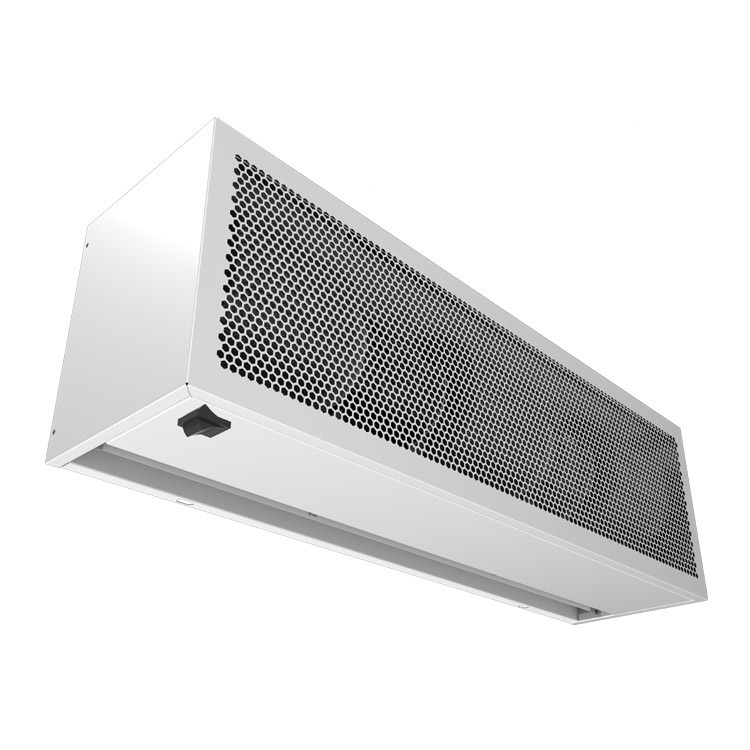
Many buyers attempt to solve loading bay problems using standard retail or light-commercial air doors. They look at the initial price tags and make a costly error. These lightweight units work beautifully over small restaurant entrances. However, they fail miserably in harsh warehouse environments. Retail units suffer from insufficient motor power and shallow air volume. Their internal blowers simply cannot generate the momentum required for a 12-foot or 14-foot doorway. Direct wind easily overcomes their weak output, rendering them useless at a shipping dock.
Securing a large, exposed doorway demands heavy-duty engineering. You must deploy an Industrial Air Curtain to achieve true environmental separation. These robust units feature specialized, heavy-duty blowers. They utilize deep internal plenums to equalize pressure before the air exits the nozzle. This creates a thick, uniform wall of moving air. They deliver exceptional high-volume output across the entire span of the opening. This industrial-grade mass provides the necessary kinetic resistance to stand firm against aggressive outdoor crosswinds.
We must address the initial price discrepancy objectively. Industrial models require a larger upfront investment than their commercial counterparts. Some facility managers try to save budget dollars by installing undersized commercial hardware. This approach virtually guarantees a 100% ROI failure. If the equipment cannot hold the air seal against typical wind loads, it provides zero protective value. You merely end up paying for a noisy overhead fan. Spending adequately on industrial capabilities ensures the barrier actually performs its intended function.
Two primary metrics govern performance under wind load: discharge velocity and air volume. Velocity measures how fast the air travels as it leaves the nozzle. Volume, measured in Cubic Feet per Minute (CFM), dictates the total mass of the airstream. You need high baseline metrics for both. Extreme velocity ensures the air reaches the floor before losing momentum. Massive CFM provides the "weight" necessary to combat negative building pressure and punch through sudden external wind gusts.
Standard industrial models handle moderate doors effectively. However, tall shipping bays demand upgraded performance. When dealing with doors exceeding 10 feet in height, standard velocity falls short. You must specify a high velocity air curtain for these massive openings. These aggressive systems maintain core stream integrity over long vertical drops. If your facility faces a wide-open plain or a windy coastal bay, extra-high-velocity models become absolutely mandatory for sustained protection.
Directing airflow straight down into the floor rarely works in windy environments. You must evaluate the nozzle design carefully. Top-tier units feature adjustable directional vanes. Evaluators must look for units allowing significant outward angling. You typically need to pitch the discharge nozzle 10° to 20° outward toward the exterior. This specific angle forces the airstream to lean into the incoming wind. It actively pushes back against horizontal pressure, keeping the resulting combined air split squarely over the threshold.
Winter crosswinds introduce severe chill factors into your loading areas. These freezing gusts endanger employee safety and risk freezing nearby plumbing. Heated configurations remain technically optional, but they prove critical in colder climates. Manufacturers offer gas, electric, or steam-heated coil options. These coils heat the airstream as it exits the blower. A heated barrier instantly offsets the chill factor during winter crosswind events. It transforms a miserable shipping bay into a comfortable, productive workspace.
Specification Guidelines for High-Wind Loading Bays
| Component Category | Commercial Standard | Industrial Requirement for Wind Load |
|---|---|---|
| Motor Power | 1/2 HP or less | 1 HP to 5 HP (Dual motors common) |
| Discharge Velocity | 2,000 - 3,000 FPM | 4,500 - 7,000+ FPM |
| Directional Vanes | Fixed or limited angle | Fully adjustable (10° to 20° outward pitch) |
| Air Volume (CFM) | Low to Moderate | Ultra-High (Provides necessary air mass) |
Sizing the unit incorrectly destroys performance instantly. The hardware must span the entire exact width of your doorway. Undersizing by even a few inches creates massive vulnerabilities. Wind behaves like water; it aggressively seeks the path of least resistance. If you leave small gaps at the left or right edges, the wind will exploit them. These gaps become high-speed wind tunnels. Contaminants and cold air will rush through the unprotected corners, undermining the entire installation.
Warehouse openings present uniquely cluttered physical environments. Installing a loading dock air curtain requires careful spatial planning. You will face numerous overhead obstacles. Installers must navigate around bulky roll-up door drums, heavy steel tracks, and dock leveler electronics. The unit must mount securely without impeding mechanical door operations. Failing to measure these mounting clearances beforehand leads to delayed installations or forces you to mount the unit too far from the wall.
Facilities often suffer from unseen internal forces. Extreme negative indoor air pressure acts like a giant vacuum. Exhaust fans continuously pull air out of the building. If no makeup air replaces it, the facility forcefully sucks air in through open bay doors. This internal vacuum easily pulls crosswinds inside. It effectively neutralizes even a perfectly sized and powerful barrier. You must address this underlying issue. Facility teams need to perform proper HVAC air balancing alongside the equipment installation.
Never purchase industrial equipment based on guesswork. You need hard data to make correct engineering decisions. Complete this simple site audit checklist before contacting any manufacturers:
You must scrutinize vendors heavily during the selection phase. Do not rely on generic marketing claims or glossy brochures. Advise your purchasing team to demand actual proof of capability. Ask the manufacturer to provide specific wind-load performance charts for their models. Request CFD (Computational Fluid Dynamics) modeling data showing how their airstream behaves under a 15 mph crosswind. Vendors who understand industrial environments will supply these technical documents gladly. Walk away from those who cannot back up their claims.
Protecting your facility requires precise expertise. Every warehouse presents unique architectural layouts and distinct environmental challenges. Off-the-shelf guessing leads to costly failures. Direct your facility management team to request a custom sizing consultation today. Seek out an engineering review tailored specifically to your exact loading bay setup. Professional evaluations ensure you procure the correct velocity, volume, and mounting hardware. Take action now to seal your perimeter, lower your energy bills, and maintain strict operational compliance.
A: No. We must establish realistic limitations for this technology. These systems function as invisible barriers, not physical steel doors. Manufacturers rate them to resist specific baseline wind speeds, typically up to 15 mph. They successfully block everyday breezes and moderate gusts. However, they cannot block severe weather, hurricanes, or gale-force winds. During extreme storms, you must close your physical loading doors to protect the facility.
A: You must follow the rule of strict proximity. Installers should mount the unit as close to the top edge of the opening as physically possible. If you leave a wide gap between the wall and the hardware, outdoor wind will sneak behind the downward airstream. Minimizing this gap ensures the vertical flow shears directly against the threshold, maximizing structural seal integrity.
A: Yes, it remains one of the most critical adjustments you can make. Pitching the discharge vanes outward directly into the wind creates a necessary kinetic counter-force. Instead of letting the wind push the air straight indoors, the angled airstream leans out to meet the pressure. This physical pushback stabilizes the flow, helping to maintain a strict vertical seal over the floor.


