


Views: 0 Author: Site Editor Publish Time: 2026-10-15 Origin: Site


Facility managers often struggle to secure high-clearance doorways. Industrial, commercial, and loading dock entrances exceeding 12 feet present a major challenge. They cause massive energy loss, uncontrolled temperature fluctuations, and severe pest infiltration. To fix this, you need a robust, engineered solution. Standard commercial units simply lack the kinetic energy required. They cannot project a cohesive air stream down to the floor. When an air stream breaks before reaching the ground, you waste your capital investment entirely.
This guide details the specific velocity metrics and blower technologies you need. We explore the exact implementation realities required to successfully seal high-clearance openings. You will discover how to calculate core requirements, select proper orientations, and design a durable barrier. By understanding these mechanical principles, you can specify an effective system without over-engineering or under-speccing your facility's solution.
Understanding environmental separation starts with basic building physics. Tall facilities behave uniquely under varying weather conditions. You must evaluate the forces acting against your doorways to specify effective equipment.
Temperature differentials in tall buildings create significant atmospheric imbalances. Warm indoor air naturally rises toward the ceiling. This vertical movement generates severe negative pressure at the ground level. We call this phenomenon the stack effect. It effectively turns your facility into a giant chimney. Negative pressure vigorously pulls unconditioned outside air in through the bottom of the door. Simultaneously, it pushes your expensive, conditioned air out through the top. Overcoming this immense pressure requires substantial downward aerodynamic force.
Air streams behave predictably over distance. They naturally widen and lose forward momentum. As the stream travels downward, surrounding stationary air creates friction. This friction slows the jet dramatically. For high doors, an air jet must remain incredibly thick and fast. It needs sufficient mass to resist internal building pressure. It also must fight off external wind loads pushing against the doorway. If the jet loses coherence, it deflects inward. Once deflection occurs, the barrier collapses completely.
Many buyers make a critical engineering mistake. They specify equipment based solely on door width. They completely ignore door height and prevailing wind loads. This oversight guarantees a broken air seal. Installing an undersized high door air curtain yields a heavily negative return on investment. The unit will consume electricity while providing zero environmental separation. You must match the equipment's aerodynamic output to the opening's physical dimensions and environmental stress.
Velocity dictates performance in environmental separation. However, many manufacturers advertise misleading data. You must differentiate between starting velocity and finishing velocity to guarantee proper function.
Evaluating performance requires looking at two distinct measurement points. Discharge velocity occurs right at the machine's nozzle. Terminal velocity occurs where the air hits the ground.
Standard vs. High Clearance Velocity Requirements
| Door Height | Typical Discharge Velocity (FPM) | Required Terminal Velocity (FPM) | Primary Application |
|---|---|---|---|
| Up to 10 feet | 1,500 - 2,500 | 300 - 400 | Retail / Light Commercial |
| 12 to 16 feet | 3,500 - 5,000 | 300 - 400 | Standard Loading Docks |
| 16 to 20+ feet | 5,000 - 6,500+ | 300 - 400 | Heavy Industrial / Hangars |
You should always rely on standardized engineering guidelines. The Air Movement and Control Association (AMCA) provides these frameworks. AMCA Publication 222 evaluates performance based on core velocity projection and stream uniformity. Certified units undergo rigorous laboratory testing. This ensures the manufacturer's performance curve chart accurately reflects real-world terminal velocity. Specifying AMCA-certified equipment removes the guesswork from your facility planning.
Baseline velocity calculations only represent ideal conditions. Facility managers must adjust these baseline requirements upward based on specific environmental factors. Coastal facilities experience strong, sustained outdoor winds. Manufacturing plants often run massive internal exhaust fans. These fans compound the building's negative pressure. You must calculate these external and internal forces. An HVAC engineer can determine how much extra terminal velocity you need to overcome these site-specific variables.
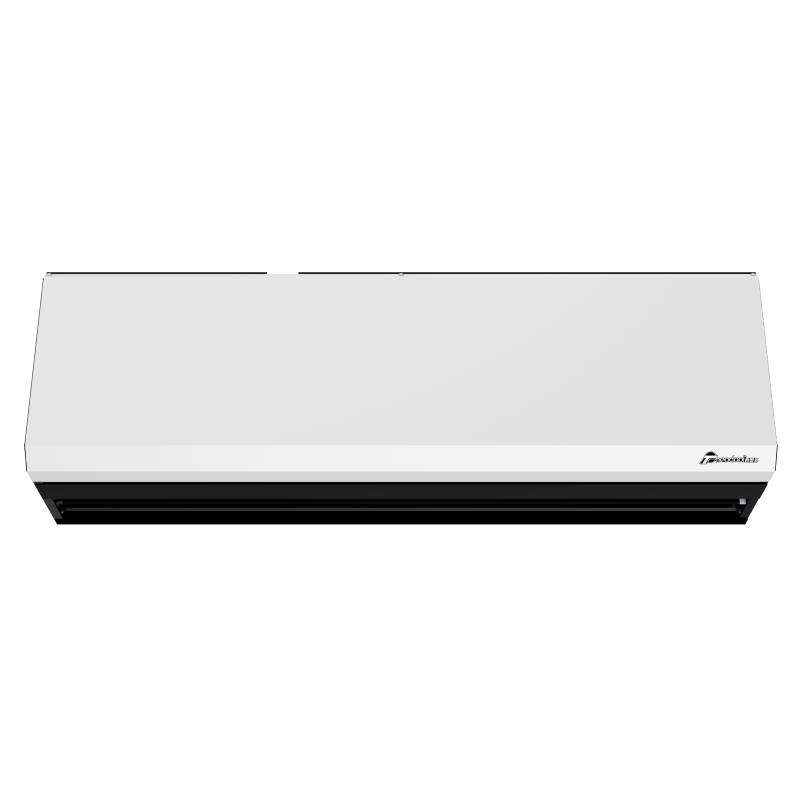
Blower technology dictates how well a system performs under stress. Not all fan designs can handle industrial environments. Tall openings demand extreme aerodynamic force that only specific mechanical designs can provide.
Retail environments commonly use cross-flow or tangential fans. These blowers provide a smooth, wide airflow. They operate quietly and work perfectly for customer-facing doors up to 10 feet high. However, they lack pushing power. For industrial heights, you must contrast this with centrifugal blowers. Centrifugal fans utilize a scrolling housing. This design aggressively accelerates the air. It trades a smooth, quiet breeze for raw, concentrated power.
A standard fan just moves air. A Centrifugal Air Curtain actively compresses it. This compression generates incredibly high static pressure. High static pressure is the exact mechanical force necessary to punch through high wind loads. It keeps the air molecules tightly packed together. This prevents the jet from fragmenting as it drops. Thanks to this compression, a well-designed centrifugal air curtain maintains a tight, cohesive air stream over 15 to 20+ feet.
Industrial applications demand immense durability. Standard commercial units utilize lightweight plastic or thin aluminum components. Conversely, centrifugal units feature heavy-duty construction. Manufacturers build them with robust industrial motors. They utilize heavy-gauge steel casings and oversized bearings. These machines are fully capable of continuous, 24/7 operation. They survive harsh loading dock environments, airborne dust, and the daily physical abuse common in active warehouses.
Installation placement directly impacts aerodynamic success. While overhead mounting remains common, structural realities often dictate alternative approaches. You must evaluate your building's architecture before committing to a specific orientation.
Top-mounted units blow air straight down from the ceiling. They leverage gravity to assist the air stream slightly. This approach keeps the equipment safely out of the daily traffic path.
Sometimes, shooting air downward simply fails. Physics dictates a maximum effective drop distance. When overhead mounting proves impossible or aerodynamically flawed, you must change the angle of attack.
Deploying industrial machinery requires careful facility planning. High-velocity systems introduce new structural and electrical demands. You must account for these realities to ensure a smooth, safe installation.
We must remain entirely transparent about acoustics. High-velocity centrifugal fans are extremely loud. They move massive volumes of air at high pressure. This generates significant aerodynamic roar. They are specifically designed for harsh industrial applications where ambient warehouse noise is already quite high. Because of this noise profile, they are absolutely not suitable for customer-facing retail entrances or quiet office corridors. Workers stationed immediately next to these doors may occasionally require hearing protection.
Generating extreme static pressure requires serious electrical muscle. Standard 120V wall outlets cannot run these machines. High-velocity units typically require dedicated 3-phase power. They demand robust electrical infrastructure to handle the necessary horsepower. Depending on the door's span and height, motors often range from 3 to 15+ HP. You must verify your facility's electrical panel capacity before approving any purchase order. Running new, high-voltage conduit to the doorway adds distinct project considerations.
Never underestimate the physical forces at play. A high-capacity centrifugal unit brings immense weight and aggressive vibration. When a 10 HP motor powers up, it generates substantial rotational torque. Mounting these directly to drywall or weak sheet metal will result in structural failure. Proper structural mounting brackets tied into steel I-beams are absolutely required. You must also install heavy-duty vibration isolators. These isolators prevent the machine from rattling the building frame and loosening wall fasteners over time.
Navigating the procurement process requires discipline. Follow this standardized 3-step checklist for buyers to ensure successful specification:
Evaluating and specifying high door solutions requires moving past basic marketing claims. You must look strictly at engineered performance data. The absolute most critical metric is the terminal velocity at floor level. If the air does not hit the ground at 300 to 400 FPM, your barrier will fail. Industrial environments demand the high static pressure generated by centrifugal blowers to overcome prevailing winds and building stack effects. Moreover, you must remain flexible in your design approach. Vertical orientations often solve the complex structural and aerodynamic challenges that top-mounted units cannot handle.
Protecting your facility's energy footprint is a major engineering task. We strongly encourage facility managers to consult with a certified HVAC engineer. Have them perform a precise building pressure analysis. Doing this before specifying your equipment ensures you install a robust, highly effective environmental seal.
A: No. Standard commercial units lack the necessary static pressure to project air effectively from that height. The stream will break apart long before it reaches the floor. This renders the unit entirely useless against prevailing wind loads, severe temperature loss, and flying pests.
A: Prices vary significantly based on width, motor horsepower, and whether the unit includes heating elements. A realistic industrial range spans from $3,000 to over $10,000. However, the operational energy savings achieved by sealing a massive doorway typically offset this upfront cost within just 1 to 3 years.
A: Unheated units are the standard choice for pure environmental separation in warehouses and loading docks. They use less electricity. However, heated units are highly recommended if employee comfort directly near the door is a priority. Keep in mind that heated industrial models require significantly more electrical power to operate.


