


Views: 0 Author: Site Editor Publish Time: 2026-09-10 Origin: Site


High-traffic supermarkets rely on open or constantly cycling automatic doors. They need these doors to reduce customer friction. But this open-door policy creates a massive vulnerability. It harms HVAC efficiency and environmental control. You lose indoor climate stability every time doors slide open. Unmanaged entrances inevitably lead to rapid thermal loss. They also cause severe refrigeration system strain. Open doors invite potential health code violations. They allow flying insects and urban dust inside. Ignoring this invisible boundary degrades food safety. It also harms overall operational stability.
Selecting the right hardware requires moving beyond generic fans. This guide provides a comprehensive technical framework. You will learn how to evaluate and specify these barriers. We base our guidelines on airflow dynamics and build quality. You will also understand daily operational realities. Protect your store environment using proven aerodynamic principles.
Supermarkets face a unique operational dilemma. You want customers to enter easily. But you must also keep outdoor weather outside. Balancing these needs requires strategic airflow management.
Uncontrolled outdoor air entering the store causes immediate thermal loss. Summer heat or winter chill disrupts your carefully managed indoor climate. Your central HVAC system works much harder to compensate. This constant infiltration directly increases daily energy consumption. It also strains open-case refrigeration units near the front of the store. Compressors run continuously to maintain safe food temperatures. Proper air barriers drastically reduce this mechanical burden. They block unconditioned air before it reaches the aisles.
Local health departments enforce strict sanitation standards. The FDA requires supermarkets to prevent pest entry. Installing a commercial entrance air curtain serves as a highly effective preventative measure. The downward airflow creates an invisible shield. Flying insects cannot penetrate a properly calibrated air stream. The system also repels urban dust and vehicle exhaust fumes. This keeps fresh produce cleaner. It also ensures your facility passes rigorous hygiene inspections.
Shoppers dislike uncomfortable drafts. Cold winter winds sweeping across the checkout zone frustrate customers. Employees working the registers also suffer. An air barrier stops these drafts completely. It keeps checkout zones and produce areas comfortable. However, you must avoid creating an intimidating noise barrier. Modern units balance air velocity with acceptable acoustic levels. Customers pass through seamlessly without noticing loud fan noise.
You must set realistic expectations regarding thermal blocking. No system provides 100% infiltration reduction. Claims of absolute separation are technically inaccurate. A properly sized unit typically delivers 70–85% efficiency. Environmental wind loads constantly challenge the air barrier. Negative building pressure also affects performance. Understanding these variables helps facilities managers plan accurately. A 75% reduction still yields massive energy savings.
Engineers design entrance solutions using specific aerodynamic models. The internal fan technology dictates the barrier's effectiveness. Supermarkets require uniform coverage across wide sliding doors.
Tangential fan technology drives the modern Cross Flow Air Curtain. The internal impeller spans the entire length of the housing. It pulls air in and forces it out in a continuous sheet. There are no gaps in the air stream. This uniformity prevents outdoor air from sneaking through weak spots. The tangential design ensures consistent velocity from edge to edge. It builds a solid wall of moving air.
Axial fans generate turbulent flow. They push air in chaotic, swirling patterns. This turbulence causes the air stream to break apart quickly. Tangential impellers generate laminar flow. The air travels in a smooth, continuous, and straight path. Laminar flow stays intact all the way to the floor. It maintains its structural integrity against outdoor wind.
| Feature | Cross Flow Technology | Axial Fan Technology |
|---|---|---|
| Airflow Pattern | Smooth, continuous, laminar sheet | Uneven, swirling, turbulent pockets |
| Coverage Uniformity | 100% gap-free across unit width | Significant gaps between fan blades |
| Noise Profile | Low decibel, consistent hum | Loud, choppy, disruptive noise |
Supermarket entrance ceilings are notoriously crowded. Sprinkler pipes, lighting, and security cameras compete for space. Cross-flow models feature a compact, low-profile design. They fit easily into tight bulkheads. You can mount them directly above automatic sliding doors. The slim housing does not interfere with architectural elements. It blends seamlessly into the retail environment.
Noise pollution severely degrades the retail experience. Loud equipment frustrates shoppers and distracts staff. Cross-flow designs operate at significantly lower decibel levels. The long, cylindrical impeller spins smoothly. It moves large volumes of air without aggressive blade noise. This acoustic advantage makes them ideal for front-of-house applications. You achieve maximum climate separation without sacrificing store ambiance.
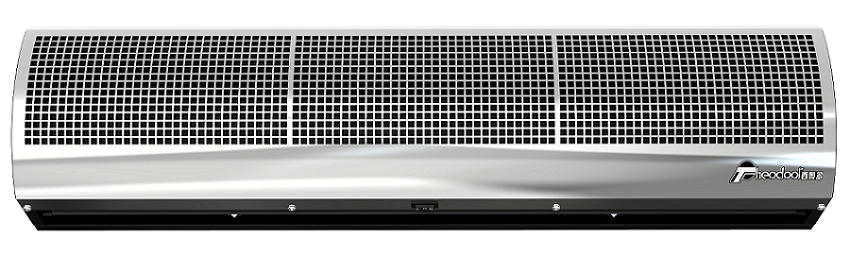
Commercial hardware must withstand demanding daily conditions. Material selection directly impacts operational uptime. Supermarkets expose entrance equipment to constant wear and tear.
Entrances face severe environmental stressors. High humidity, seasonal weather changes, and rain blow directly onto the housing. Store employees also use chemical cleaning agents on nearby surfaces. Mild steel rusts quickly under these conditions. Powder-coated plastics become brittle over time. A true stainless steel air curtain prevents premature degradation. Grade 304 or 316 stainless steel resists oxidation naturally. It repels moisture and withstands aggressive sanitation protocols.
Modern supermarkets prioritize clean, upscale architectural designs. Bulky plastic equipment looks unprofessional above a grand entrance. Brushed stainless steel offers a premium, timeless finish. It aligns perfectly with existing commercial refrigeration units. The metallic texture matches checkout counters and deli cases. This visual consistency elevates the entire store aesthetic. It projects an image of cleanliness and quality to customers.
Metal fatigue ruins inferior units long before the motor dies. Vibrations from continuous operation weaken plastic chassis joints. Rust compromises the structural integrity of mild steel mounts. Stainless steel eliminates these mechanical failures entirely. The rigid chassis absorbs motor vibrations safely. The housing remains structurally sound for decades. This durability ensures the internal impellers stay perfectly aligned. Factory-rated airflow performance remains consistent year after year.
You cannot guess the required specifications. Precise sizing dictates whether the barrier actually works. An underpowered unit wastes electricity while providing zero protection.
Air velocity is the most critical metric. We measure this speed in Feet Per Minute (FPM). The golden rule of specification focuses on terminal velocity. The air stream must maintain a minimum velocity precisely where it hits the floor. Industry standards dictate a minimum of 400 FPM at floor level. If the speed drops below this threshold, the barrier breaks. Wind simply pushes through the weak air stream.
You must match motor specifications to your exact entrance height. Standard grocery store doors usually stand 8 feet tall. Architectural entrances or warehouse delivery bays often reach 12 feet. A motor designed for an 8-foot door will fail on a 12-foot opening. The air will dissipate before reaching the ground. Facilities managers must specify heavy-duty motors for taller applications. Stronger impellers guarantee the air stream reaches the floor intact.
| Entrance Height | Minimum Floor Velocity Required | Recommended Motor Tier |
|---|---|---|
| 7 to 8 Feet (Standard) | 400 FPM | Commercial Grade (Standard Power) |
| 9 to 10 Feet (Elevated) | 400 FPM | High-Velocity Commercial Grade |
| 11 to 12+ Feet (Architectural) | 400 FPM | Heavy-Duty Industrial Grade |
The unit must cover the entire door opening. Never install a 6-foot unit over an 8-foot door. The supermarket air curtain should actually overlap the door frame slightly. We recommend a 1-inch to 2-inch overlap on each side. This overlap prevents edge-leakage. We call this leakage the "spill effect." Outdoor air will always seek the path of least resistance. Overlapping ensures tight coverage at the corners.
Internal building pressurization affects performance heavily. Exhaust fans in the bakery and deli create negative building pressure. This pressure acts like a vacuum, sucking outdoor air inside. External wind loads push against the barrier simultaneously. You must angle the discharge nozzles to fight these forces. Installers usually aim the louvers 5 to 15 degrees outward. This slight outward angle pushes back against incoming wind. It stabilizes the air barrier effectively.
Great hardware fails if installed poorly. You must manage structural, electrical, and maintenance realities carefully. Avoid common installation mistakes to guarantee long-term performance.
Commercial units carry significant physical weight. You cannot attach them to weak drywall ceilings. Installers must reinforce the bulkhead structural framing. The header must support dynamic vibration loads, not just static weight. For drop-ceiling applications, use threaded rod installations. Anchor the rods directly into the true concrete ceiling above. This ensures absolute stability and prevents dangerous mounting failures.
Automated control is mandatory for commercial units. You should never wire them for "always-on" continuous operation. Running motors 24/7 burns out bearings prematurely. It also wastes massive amounts of electricity. Integrate the system with the automatic door sensors. You can also use heavy-duty magnetic door switches. The unit should power up instantly when the door opens. It should power down a few seconds after the door closes.
Proper airflow requires unobstructed intake zones. The unit pulls ambient air through its top or front grille. Installers frequently make the mistake of blocking this intake. They mount the unit too close to ceiling tiles. Sometimes store managers hang promotional signage directly over the grille. Starving the motor of air destroys performance. The unit cannot project air downward if it cannot pull air inward. Maintain at least 4 inches of top clearance.
Neglect destroys aerodynamic efficiency. Dust buildup changes the weight of the fan blades. It throws the impellers off balance. Follow a strict baseline upkeep schedule to maintain factory-rated airflow.
Successful supermarket airflow planning requires precise execution. You must balance mechanical efficiency with a pleasant retail environment. Relying on properly sized equipment protects your HVAC investments instantly. Upgrading to the right technology transforms your entrance into an active climate shield.
We encourage facilities managers to conduct a comprehensive entrance audit immediately. Measure your specific door dimensions. Check your building for negative air pressure issues. Verify your ceiling clearance. Gather these exact metrics before requesting a technical quote.
A: No, they supplement primary doors during operational hours. They reduce massive energy loss when automatic doors cycle open. You still need physical doors to secure the building after hours and overnight.
A: Yes. They act as an invisible thermal shield. They trap your conditioned air inside the building. The barrier works effectively whether your central HVAC system is currently set to heating or cooling.
A: It depends heavily on your regional climate. Unheated ambient units are often sufficient for pure climate separation. However, heated units greatly improve staff and customer comfort in regions with severe, freezing winters.
A: Modern commercial units operate at very reasonable decibel ranges, usually between 55 and 65 dB. This sound level easily blends into normal ambient supermarket background noise without disturbing shoppers.


