


Views: 0 Author: Site Editor Publish Time: 2026-10-12 Origin: Site


Securing a 6-meter (approximately 20-foot) industrial doorway presents a severe aerodynamic challenge for facility managers. Standard commercial air curtains are simply not engineered to maintain seal integrity at this massive distance. At 6 meters, gravity acts aggressively on the downward airstream. Indoor and outdoor pressure differentials further disrupt the airflow before it ever reaches the ground. Heavy crosswinds rapidly degrade the air barrier. If the air does not reach the floor with sufficient terminal velocity—typically 2 to 3 meters per second—the investment yields absolutely zero energy savings or environmental separation. For doors of this immense scale, specifying the correct blower technology and mounting configuration is the only way to achieve a verifiable return on investment. In this comprehensive guide, we will explore the physics of high doors. You will discover exactly which technologies succeed and how to correctly implement them in your industrial facility.
Understanding the physics of airflow is crucial when dealing with massive industrial entrances. The momentum problem is the most significant hurdle facility managers face. Airflow loses kinetic momentum exponentially as it travels away from the discharge nozzle. Standard cross-flow fans, often called tangential fans, generate a wide, smooth stream of air. This type of airflow feels incredibly strong when you stand directly underneath the unit. However, this wide air stream completely dissipates around the 3.5 to 4-meter mark. The air simply lacks the focused kinetic energy required to complete a 6-meter vertical drop.
Beyond simple gravity and momentum loss, pressure differentials wreak havoc on industrial door seals. Large industrial facilities frequently experience a phenomenon known as the "stack effect." Warm air naturally rises to the ceiling and escapes through roof vents or upper-level leaks. This creates a negative pressure zone at the floor level. The building literally vacuums cold outdoor air in through lower doorways. Heavy wind loads blowing against the exterior of the building further complicate this aerodynamic environment. If you deploy a weak airstream at the floor level, outdoor air will easily penetrate it. Dust, debris, and flying insects will also blow right through the compromised barrier.
We must strictly warn buyers against the cost of under-specifying equipment. A common procurement mistake involves buying oversized standard commercial units to save money upfront. Installing these inadequate units results in continuous daily power consumption. Meanwhile, the facility gains absolutely no actual environmental separation. The air stream breaks apart halfway down the door. You spend money on electricity to run fans that accomplish nothing. This scenario results in a highly negative return on investment. Upgrading to the proper industrial technology is not just recommended; it is strictly mandatory for a 6-meter doorway.
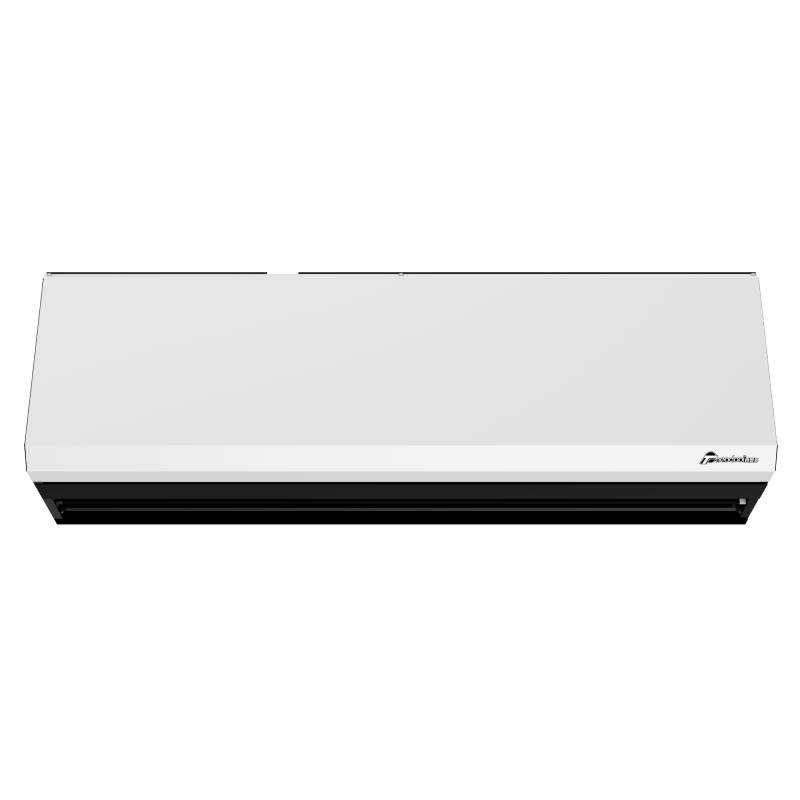
To successfully bridge a massive 6-meter gap, you need heavy-duty industrial blower equipment. We introduce the centrifugal air curtain as the foundational solution for these demanding environments. Centrifugal blowers function entirely differently from standard tangential fans. They actively pull air into a rigid scroll housing and compress it tightly. After compression, the blower expels the air forcefully through a specialized, narrow discharge nozzle. This intense compression cycle generates significantly higher static pressure. High static pressure is the exact mechanical requirement needed to push air down a 20-foot vertical drop.
Deploying this advanced technology delivers two highly specific performance outcomes. First, it generates a highly focused air jet. The dense, high-velocity airstream maintains its structural integrity over the full 6-meter distance. It refuses to fragment or billow outward like standard commercial airflow. Second, it guarantees successful floor-level deflection. The airstream hits the concrete floor with immense physical force. This impact creates the necessary "split" at the ground level. A proper split forces outdoor air safely outside while pushing conditioned indoor air back inside the building.
We must maintain transparency regarding the trade-offs of this technology. Heavy-duty centrifugal air curtains are substantially heavier than standard models. They require highly robust mounting structures. They also consume more operating power because they physically compress the air. Furthermore, they generate a higher decibel (dB) output during operation. You must frame these factors as necessary industrial trade-offs. You are trading quiet, low-power operation for actual, measurable environmental effectiveness. In a heavy industrial setting, stopping wind and retaining building heat vastly outweighs the need for whisper-quiet fan operation.
Sometimes, top-mounting an industrial unit is practically impossible due to architectural constraints. We frequently encounter scenarios where a traditional top-mounted high door air curtain simply will not fit. Your facility might feature large rolling overhead doors. The massive steel housing for these doors often blocks the necessary top clearance space. Heavy indoor crane rails might sit directly above the doorway opening. In older manufacturing facilities, the structural headers might be too weak to support a heavy machine safely.
When you encounter these physical obstacles, you must fundamentally change your approach. We introduce the vertical air curtain as the primary alternative solution. Instead of pushing air downward, you mount these specialized units vertically on one or both sides of the door. They shoot air horizontally across the entrance.
Let us examine the specific design logic for securing 6-meter doors vertically:
Vertical configurations also offer a tremendous, often overlooked maintenance advantage. Your facility maintenance team can access these tall units directly from the ground level. You completely eliminate the expensive need to rent scissor lifts or set up scaffolding. Routine tasks like filter cleaning, motor lubrication, and safety inspections become significantly faster. This grounded access drastically improves workplace safety and reduces annual maintenance labor costs.
Evaluating industrial air barriers requires strict attention to the correct engineering metrics. Buyers often focus on the wrong specifications when reading manufacturer cut sheets. We instruct buyers to completely ignore "velocity at the nozzle" claims. Extremely high nozzle velocity looks impressive on marketing brochures. However, the only metric that dictates success for a 6-meter door is the terminal velocity. The airstream must maintain a velocity of at least 2 to 3 meters per second at 0.5 meters above the floor. If it fails this test, the barrier will collapse under wind load.
Heating requirements also demand very careful evaluation. You must analyze the return on investment before adding electric or hot water heat. At a 6-meter mounting height, heated air travels a massive distance downward. It mixes with ambient air and cools significantly before it ever reaches the floor. Heated units at this height are generally used strictly for employee comfort. They prevent sudden cold blasts from freezing forklift drivers passing through the opening. They should never serve as the primary heating system for your entire facility.
You must verify your building's voltage and electrical phase compatibility early in the planning stage. Heavy-duty centrifugal motors draw substantial electrical current to achieve high static pressure. They almost always require 3-phase industrial power, such as 480V or 575V. Standard single-phase commercial power simply will not suffice for motors of this size and strength.
Noise tolerance is another critical evaluation factor for your team. You must provide realistic expectations for the decibel levels these machines produce. Since 6-meter doors typically exist in busy warehouses, aircraft hangars, or manufacturing plants, ambient noise is usually quite high. The ambient facility noise usually masks the sound of the air barrier equipment. Nevertheless, you must verify the decibel ratings against OSHA guidelines. Ensure the noise levels comply strictly with local workplace safety regulations to protect your workforce.
| Blower Technology Type | Maximum Effective Range | Static Pressure Generation | Best Application Scenario |
|---|---|---|---|
| Cross-Flow (Tangential) | Up to 4 meters maximum | Low to Moderate | Retail stores, light commercial doorways |
| Centrifugal Power | 6 to 8 meters safely | Very High | Heavy industrial sites, large warehouses |
| Vertical Configuration | Dependent on horizontal width | Very High | Obstructed headers, extremely wide entrances |
Purchasing the correct heavy-duty equipment solves only half of your aerodynamic problem. The physical installation process poses several serious risks that you must carefully manage. Structural integrity represents your first major installation hurdle. Heavy-duty centrifugal units weigh significantly more than standard commercial fans. A licensed structural engineer must thoroughly evaluate your proposed mounting substrate. Solid concrete walls and heavy steel I-beams usually provide more than enough support. However, hollow masonry blocks or thin metal siding will likely fail under the sheer weight and vibration of the equipment.
Modern industrial facilities require smart building automation. We strongly recommend pairing your new unit with heavy-duty activation sensors. Industrial magnetic door switches or robust optical sensors work perfectly in these environments. Ensure your installation team ties the unit directly into your Building Management System (BMS). The system must be programmed so the unit only runs when the door actually opens. This vital automation step maximizes your overall energy efficiency and greatly extends the motor's functional lifespan.
Finally, commissioning requires precise physical adjustments from your installers. The installation process is never truly finished just because the machine is bolted securely to the wall. The directional discharge vanes require careful manual angling. Technicians typically angle the vanes 10 to 15 degrees outward toward the exterior environment. This slight outward tilt specifically combats prevailing wind conditions outside your building. It forces incoming wind to crash against the outward-leaning air stream and bounce away. You must test the floor-level air split with tissue paper or smoke generators to confirm total accuracy.
Protecting a massive 6-meter industrial doorway requires robust engineering, careful electrical planning, and strict adherence to physics. By understanding how airstreams behave at extreme heights, you can avoid costly procurement mistakes. Keep these final action-oriented logic steps in mind as you finalize your facility upgrades:
A: No. Stacking horizontal units does not multiply their downward throw distance. The kinetic energy of the air will still dissipate around 4 meters. You need a blower specifically designed for high static pressure to cross the 6-meter gap effectively.
A: They typically operate between 65 dB and 80 dB, depending heavily on the specific model and selected fan speed. Manufacturers design them specifically for industrial environments where this operational noise level blends seamlessly into existing ambient facility sounds.
A: Only if personnel are working directly inside the doorway and require immediate protection from severe wind chill. For pure energy savings and environmental separation in a warehouse setting, an unheated, ambient unit is usually much more cost-effective.


