


Views: 0 Author: Site Editor Publish Time: 2026-09-26 Origin: Site


Opening a cold room door instantly triggers an invisible battle. Dense, frigid air spills aggressively out the bottom of the doorway. Meanwhile, warm, humid ambient air rushes in at the top. This clash causes massive energy loss. It creates severe temperature fluctuations. It also forms dangerous ice buildup on facility floors. You need a reliable aerodynamic barrier to stop this environmental exchange.
An Industrial Air Curtain solves this problem perfectly. It creates a powerful kinetic barrier across the open doorway. However, it only works if you calibrate the air velocity correctly. You must match the air volume and speed to your specific door height. You also must account for your facility temperature differential (ΔT).
This guide provides facility managers and engineers detailed technical baselines. You will learn how to evaluate specific airflow requirements. We will show you how to size and specify the exact air velocity needed for your cold storage doors.
Understanding airflow physics is essential for proper equipment selection. Cold environments behave differently than standard commercial spaces. Air behaves like a fluid, and temperature changes its density dramatically.
Cold air is dense and heavy. Warm air is light and humid. When a freezer door opens, gravity pulls the heavy cold air downward. It spills rapidly out onto the warm warehouse floor. At the exact same time, lighter warm air rushes into the freezer near the top of the door frame. Engineers call this phenomenon the stack effect. It creates a continuous cycle of energy waste. A physical barrier must stop this aggressive air movement.
Buyers often confuse two crucial measurement metrics. You must understand the difference to specify the correct unit.
You need high velocity to build a stiff, impenetrable air wall. High volume alone cannot stop a cold air spill. A blower moving massive amounts of air at low speeds acts like a gentle breeze. It will not penetrate the dense freezer climate. You must prioritize FPM when reviewing technical specifications.
Your industrial air door must generate immense kinetic energy. Kinetic energy relies heavily on velocity. The air stream pushes back against the conflicting pressure zones. It slices through the dense freezer air to seal the gap. If the unit lacks sufficient velocity, the stack effect simply bends the air stream inward or outward. The barrier shatters. Only high-velocity streams carry enough kinetic energy to maintain a rigid seal from the top of the door down to the floor.
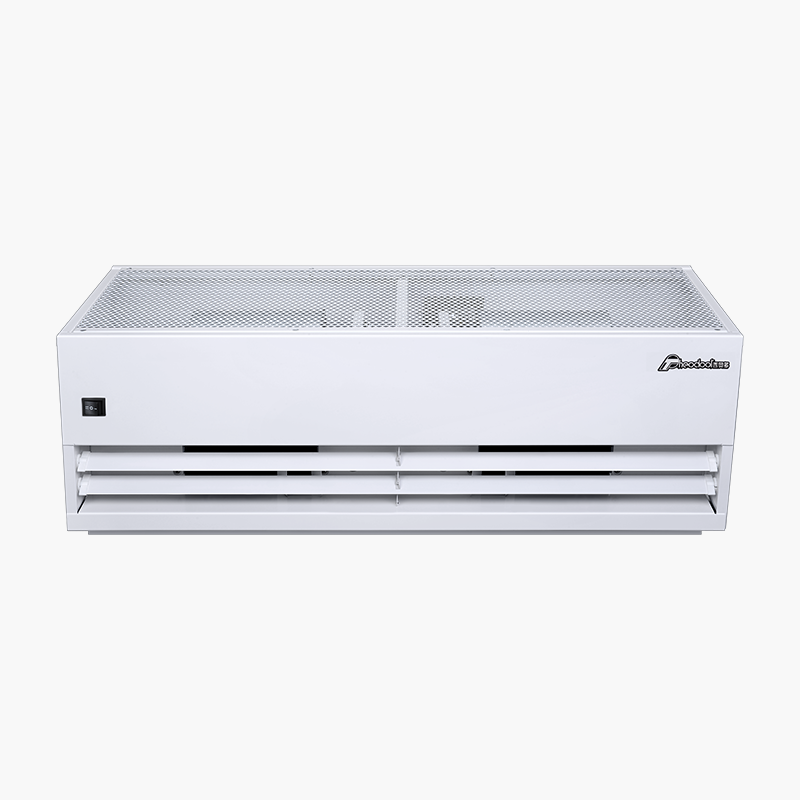
Hitting the correct velocity targets determines the success of your installation. Airflow decays naturally as it leaves the equipment. You must plan for this degradation.
Air velocity always peaks right at the unit nozzle. The discharge speed must be exceptionally high to survive the journey to the floor. For a standard 10 to 12-foot cold room door, discharge velocities routinely exceed 3,500 FPM. Taller doors demand even higher starting speeds. The nozzle acts as the launch pad. It focuses the air into a tight, sharp blade. If the nozzle velocity is too low, the jet expands too quickly. It loses its piercing power before reaching halfway down the opening.
The air stream loses momentum as it travels downward. Ambient air creates friction. Conflicting temperature zones push against the stream. A successful installation requires specific terminal velocities near the ground.
Standard retail units fail miserably in cold storage environments. Retail units use axial fans designed for quiet, low-pressure operation. Cold rooms demand heavy-duty equipment. You must install a high pressure air curtain. These units utilize powerful centrifugal blowers or high-efficiency EC motors. Centrifugal blowers compress the air. They maintain a tight, uniform airstream against immense static pressure. The high-pressure stream does not fray halfway down the opening. It cuts through the dense freezer air like a knife.
| Application Type | Door Height | Min. Discharge Velocity (FPM) | Min. Floor Velocity at 3ft (FPM) |
|---|---|---|---|
| Standard Cooler (Above Freezing) | 8 to 10 Feet | 3,000 - 3,500 | 400 - 600 |
| Walk-in Freezer (Below Freezing) | 10 to 12 Feet | 4,000 - 4,500 | 600 - 800 |
| Deep Industrial Freezer | 12 to 14+ Feet | 5,000+ | 800 - 1,000+ |
No two cold storage facilities operate identically. Environmental variables drastically alter your velocity requirements. You must calculate these factors before selecting a unit.
Air stream velocity dissipates logarithmically. The farther the air travels, the faster it loses speed. Door height acts as your primary sizing multiplier. A 14-foot door requires exponentially more discharge velocity than an 8-foot door to achieve the exact same floor-level FPM. You cannot scale linearly. An underpowered unit on a tall door leaves a massive unprotected gap at the bottom. The heavy cold air will easily spill through this weakness.
The temperature gap between spaces dictates the pressure difference. You must calculate the ΔT. Subtract the internal freezer temperature from the ambient warehouse temperature. A larger difference creates a stronger pressure differential.
Imagine your ambient warehouse sits at 70°F. Your deep freezer operates at -10°F. You face a severe 80°F temperature differential. This extreme gap forces the heavy cold air out rapidly. You will need significantly higher air velocity to counteract this intense outward force. A small ΔT requires less kinetic energy to seal the doorway.
Facilities rarely maintain perfect neutral pressure. Warehouses frequently experience negative building pressure due to massive exhaust fans. Nearby loading docks generate aggressive cross-drafts. Forklift traffic displaces air constantly. These external forces push and pull against the doorway. They can easily bend a weak air stream inward or outward.
You must over-engineer the velocity to compensate for these environmental realities. A robust cold storage air curtain acts as a structural shield. It resists crosswinds and negative pressure spikes. It keeps the invisible barrier rigid during chaotic warehouse operations.
Selecting the right equipment requires careful attention to internal components. Do not rely solely on external dimensions. You must evaluate the internal architecture.
The motor and blower drive the entire system. Look for direct-drive centrifugal fans. You can also specify EC (Electronically Commutated) motors. Centrifugal fans generate high static pressure. EC motors deliver high velocity consistently. They achieve this performance without excessive energy consumption. Belt-driven models often lose efficiency over time. Direct-drive components ensure maximum power transfer from the motor to the air stream.
Deep freezers present unique freezing risks. You must evaluate ambient humidity levels. Humid warehouse air hits the freezing unit casing. Condensation forms immediately. This moisture can freeze onto the fan blades and internal nozzles. Ice buildup destroys motor balance and ruins airflow. Evaluate whether you require an electrically heated unit. Small heating elements prevent condensation. They keep the internal components free of ice.
Fixed nozzles limit your flexibility. The unit must feature adjustable directional air vanes. You need to angle the air stream to fight the stack effect properly.
This outward angle aggressively counters the spilling cold air. The cold air pushes the angled stream perfectly straight by the time it reaches the floor.
Fast-acting roll-up doors open in milliseconds. Your barrier must activate instantly. Delay causes massive energy loss. Ensure the unit offers seamless integration capabilities. It must connect to heavy-duty limit switches. Magnetic or mechanical switches work reliably in industrial environments. The blower must hit maximum velocity the exact millisecond the physical door begins to open. Seamless PLC integration ensures flawless timing.
Poor installation ruins perfect equipment. Avoid these common implementation failures to protect your facility.
Many facility managers try to cut upfront costs. They install standard commercial-grade units over industrial freezer doors. This decision guarantees failure. The weak air stream breaks completely at 6 feet. Massive cold air escapes underneath. Warm air rushes in above. This causes severe fogging inside the freezer. Forklift drivers lose visibility. Furthermore, escaping cold air freezes ambient humidity on the warehouse floor. This ice creates catastrophic slip-and-fall safety hazards. Undersizing costs far more in energy loss and liability than it saves in purchase price.
Placement dictates performance. You must mount the units completely flush against the wall. Place them directly above the doorway. Any gaps between the unit and the wall act as bypass tunnels. Cold air will simply flow behind the machine, ignoring the air stream entirely.
Sometimes, existing rolling doors block the wall space. You must use specialized stand-off brackets in these situations. However, you cannot leave the resulting gap open. You must meticulously seal the space between the extended unit and the wall. Use heavy-duty metal flashing or insulated panels to block bypass air.
Cold storage environments punish mechanical equipment. Ambient moisture constantly gets pulled into the blower housing. Failing to account for this moisture leads to rapid mechanical failure. Ice accumulates heavily inside the blower housing. It throws the centrifugal fans out of balance. The resulting vibration destroys motor bearings. You must implement routine defrost cycles. Proper maintenance schedules protect the equipment and ensure reliable velocity over the unit's lifespan.
Protecting your cold storage facility requires precision. You must deploy the exact kinetic energy needed to stop the stack effect. High velocity serves as your primary defense mechanism against energy waste and ice formation.
A: No. Standard units lack the velocity and static pressure required to combat the high density of freezer air. The heavy cold air will easily break a weak air stream. This failure leads to massive energy loss, intense fogging, and dangerous ice formation on the facility floor.
A: Generally, you should angle the nozzle 10 to 15 degrees outward into the warmer, ambient space. This slight outward pitch aggressively counteracts the outward pressure of the spilling cold air, resulting in a straight, effective barrier by the time the air hits the floor.
A: No. In cold storage environments, it acts as a secondary barrier. It is designed to protect the opening strictly while the primary high-speed roll-up or sliding door remains open for forklift traffic. It does not replace insulated physical doors.
A: Use a calibrated anemometer. First, measure the FPM directly at the discharge nozzle. Next, take measurements 3 feet above the floor, and then 1 foot above the floor. Take these readings across the entire width of the doorway to ensure stream uniformity.


